

Thanksgiving Window Display Ideas: Styling the November Gap
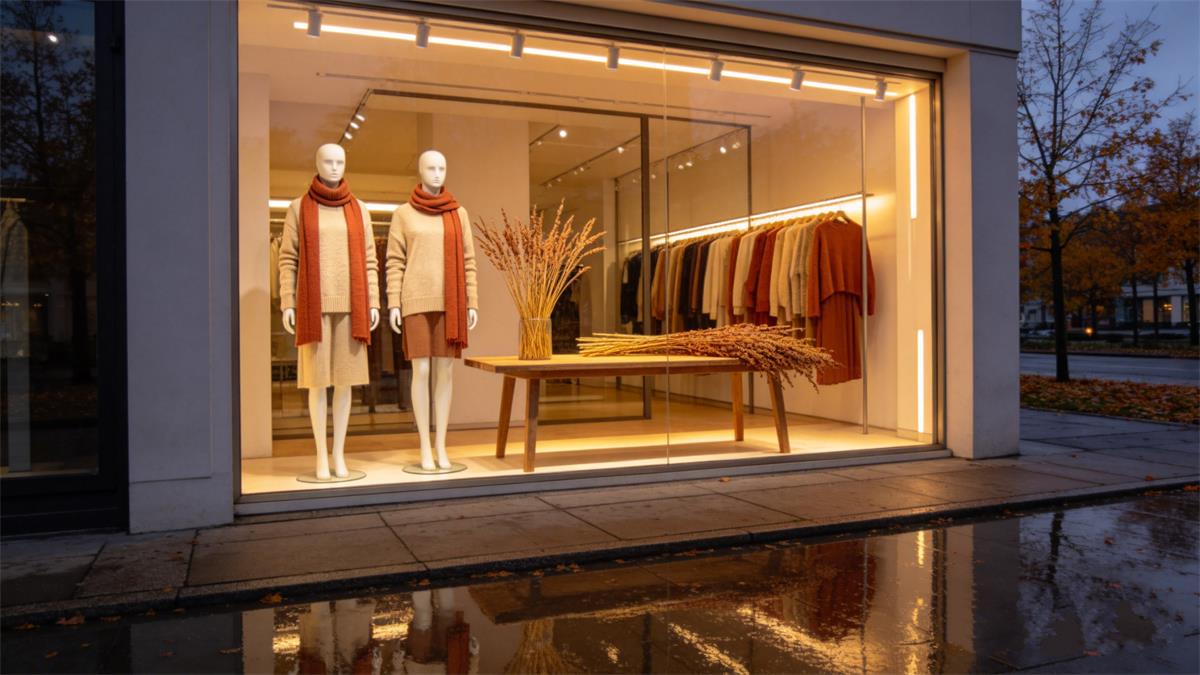
Thanksgiving window display ideas are the themes, lighting and mannequin plans a boutique uses between November 1 and the Wednesday before Thanksgiving, when the Halloween build is already down and the holiday build is still too early to install. For most US apparel stores that is a three to four week stretch with no gift category to sell and no obvious merchandise story, which is exactly why it gets neglected. The neglect is expensive. Deloitte's 2025 Holiday Retail Survey found that 70% of holiday shoppers plan to shop during Thanksgiving week, up 23 percentage points over the last five years, and that traffic is likely to peak between late November and early December rather than on a single weekend. The customers are already moving past your glass. The window decides whether they stop.
This guide treats the November stretch as a trading period rather than a decoration exercise. It covers why the November gap decides your quarter, when the window should go up and come down, three directions that work for a boutique with limited storage, what the mannequins should wear when there is nothing gift-shaped to sell, how to light glass after the clocks change, and how to hand the window to Black Friday without a rebuild.
What is the November gap, and why does it decide your fourth quarter?
The November gap is the stretch between taking Halloween down and installing holiday, and it is the only part of the retail calendar where a boutique asks customers to buy for themselves. Every other Q4 node sells a decision: Halloween a costume, Black Friday a price, Christmas a gift. Thanksgiving sells nothing that fits in a box, so the window has to sell a wardrobe instead. That is a different job from any other window you build all year, which is why so many stores default to pumpkins and a banner.
The data says the audience is there even when the pavement looks quiet. In NRF's Thanksgiving weekend survey, 84% of consumers had already begun their holiday shopping by the time the weekend arrived and still had a little over half of their list left, which means the shopper walking past on November 8 is not waiting for Black Friday. Deloitte found that 24% of shoppers' budgets is likely to be exhausted by the end of October, the highest share in five years, which pushes the remaining spend earlier into November. The month is quieter than the weekend that closes it, but it is not empty.
| What the data shows | What it means for your window |
|---|---|
| 70% of holiday shoppers plan to shop during Thanksgiving week, up 23 points in five years (Deloitte) | The week is now a destination, so the window has to be finished before it starts, not during it |
| 24% of shoppers' budgets are likely gone by the end of October, the highest in five years (Deloitte) | Early-to-mid November is when discretionary spend is still available, not a dead zone |
| Traffic is expected to peak between late November and early December (Deloitte) | Late November is a ramp, so the November window is the on-ramp to the peak |
| 84% of consumers had already started holiday shopping by Thanksgiving weekend (NRF) | Your November passerby is already a shopper, not a browser |
| Clothing and accessories were the top gift category at 51% (NRF) | Apparel is the category this audience is already primed to buy |
What the 2026 calendar actually looks like
Thanksgiving falls on Thursday, November 26, 2026, which puts the install decision in the last week of October and the trading period across four full weeks. Canadian boutiques should not copy this calendar: Canadian Thanksgiving is on Monday, October 12, 2026, so the gap north of the border sits between that date and the first week of November. Treat the US window as the four weeks ending Wednesday, November 25.
When should a Thanksgiving window display go up and come down?
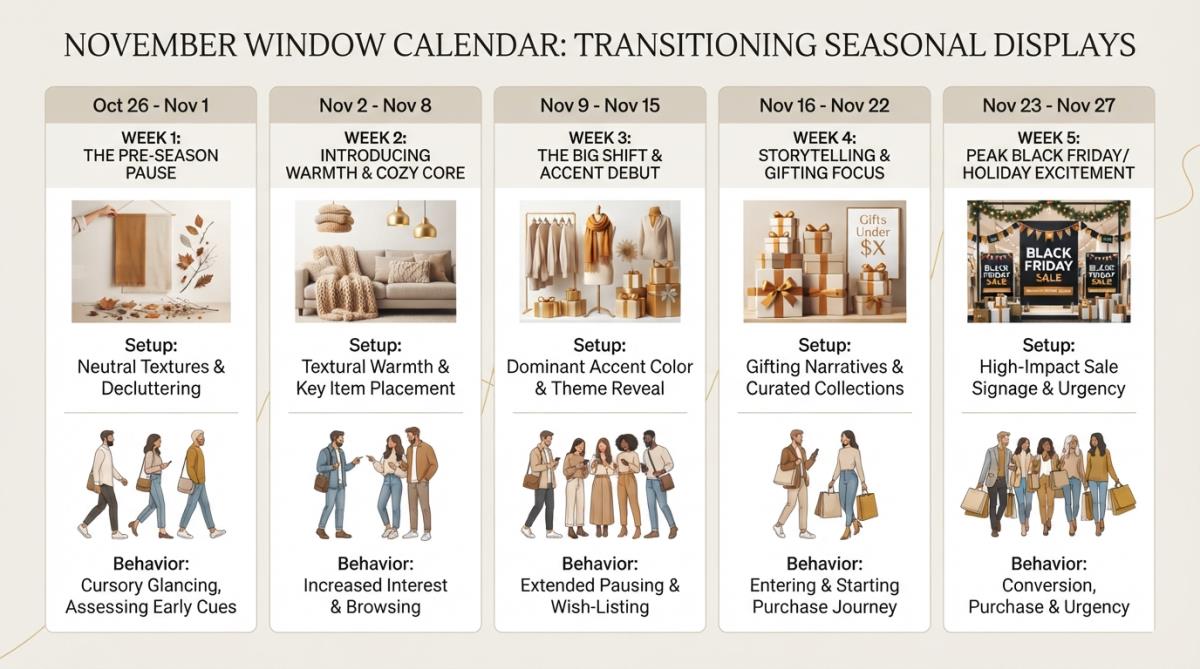
Install in the last days of October or the first week of November, and treat November 1 as a hard reset day rather than a slow fade. Halloween windows that linger into the second week of November cost you the only stretch where a customer is shopping for herself, because by mid-month the holiday message starts pulling attention toward gifting. The install should take about half a day if the Halloween build comes down to a neutral platform rather than the floor.
| Period | What shoppers are doing | What the window has to do | Practical move |
|---|---|---|---|
| Oct 26 to Nov 1 | Halloween is finishing, no holiday intent yet | Clear Halloween out completely, hold a neutral base | Strip to platform, backdrop and lighting. Leave nothing orange behind |
| Nov 2 to Nov 8 | Early November shopping begins, budgets still intact | Introduce warmth and an autumn-to-winter wardrobe story | Install the full Thanksgiving build. This is the quiet week that rewards you on the 20th |
| Nov 9 to Nov 15 | Mid-month lull in foot traffic, intent still building | Hold the story, refresh the front layer only | Rotate one accent, bring forward heavier knitwear as weather turns |
| Nov 16 to Nov 25 | Pre-holiday ramp, promotional weeks begin | Show Thanksgiving atmosphere plus a first gift-ready layer | Add the holiday layer on top. Never rebuild |
| Nov 26 to Nov 27 | Thanksgiving, then Black Friday | Become a wayfinding tool first | Swap the front layer for one legible price message |
The coming-down decision matters as much as the going-up one. Take the Thanksgiving build out across the weekend after the holiday rather than leaving it for December, because a harvest scene sitting in glass on December 5 tells a customer the store is not paying attention. This is also why the base layer should be neutral from day one: if the platform, backdrop and lighting are already not seasonal, the swap takes an hour.
Which Thanksgiving window display ideas work for a boutique?
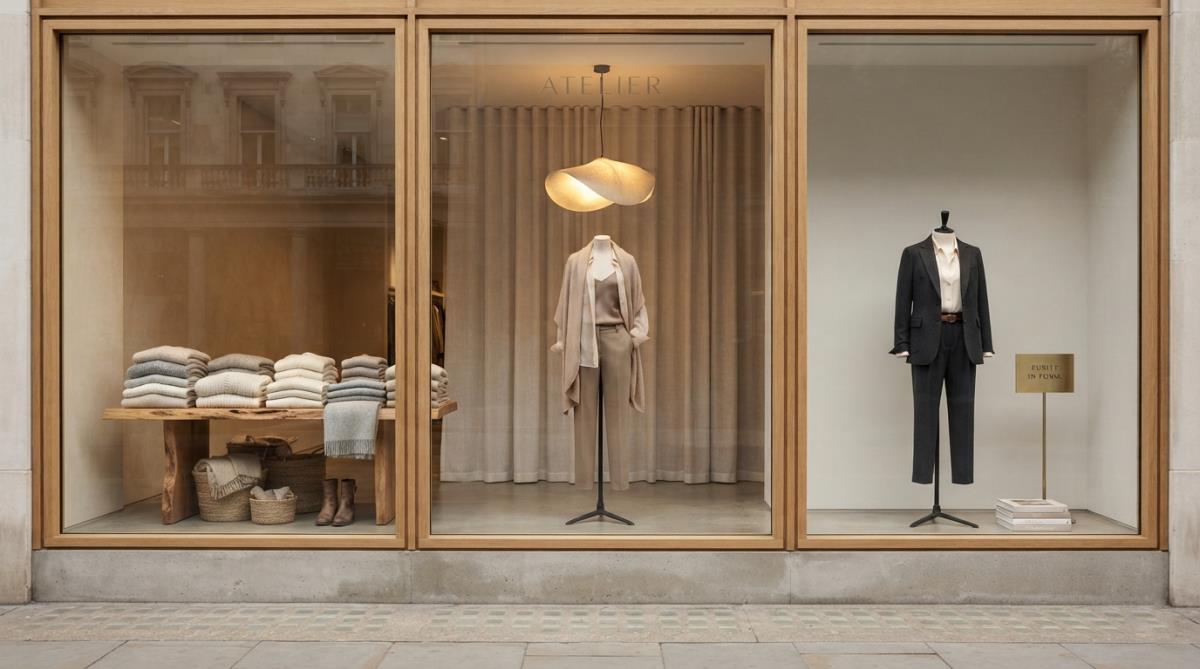
Three Thanksgiving window display ideas work reliably in a small window, and all three reuse the same neutral base. What separates them is how much merchandise they carry and how much storage they need afterwards.
Harvest table. Build a single low table or crate cluster in one corner of the window, at a height of about sixteen to twenty inches, with two or three harvest objects and one garment folded on top. It suits homeware and lifestyle boutiques, and packs down into one crate after the holiday.
Warm light and texture. Skip the pumpkins and build the window out of light and material: warm bulbs at around 2700K to 3000K, a wool throw, a knit scarf, bare painted branches, and one form in a layered autumn outfit. It costs the least, stores the flattest, and ages into December better than any prop-based scene.
Gratitude, done commercially. A message-led window with one short, well-set line of text and the product as the hero beneath it. The mistake is making the message the whole display. A window that is mostly a banner sells nothing, while one restrained line above a styled outfit sells both.
| Direction | Focal point | Prop load | Merchandise it carries | Best for |
|---|---|---|---|---|
| Harvest table | Low table or crates at 16 to 20 inches | High, 6 to 10 objects | Folded knitwear, homeware, gift bundles | Lifestyle, homeware and gifting stores |
| Warm light and texture | One lit, layered form | Low, 3 to 4 pieces | Full outfits, outerwear, layering | Apparel boutiques with limited storage |
| Message-led gratitude | One restrained line of text | Very low, 1 to 2 pieces | The hero outfit directly beneath it | Small windows under 6 feet wide |
Whatever the direction, one rule holds: the merchandise has to be the brightest and most detailed thing in the window. Props support the product, and the moment a prop is more interesting than the garment, the window has stopped selling.
What should the mannequins be wearing in a Thanksgiving window?
Dress the forms for the weather the customer is walking through, which in late November means layering rather than outerwear. The Thanksgiving window sits at the moment when a customer needs a coat but is not yet buying one, so the commercial job is to sell the three pieces underneath it. Show one complete outfit rather than three separate garments, and show it in a layer a customer can still wear indoors.
Aim for one form in a complete look, one in the same look a layer lighter, and any third form carrying an accessory-led variation. That answers the two questions a November shopper brings inside: what do I wear now that it is cold, and what do I wear to the gathering. It also lifts transaction value, because a customer who sees a scarf, a knit and a coat styled together buys three items while one who sees a rail buys one.
How many forms, and where should they stand?
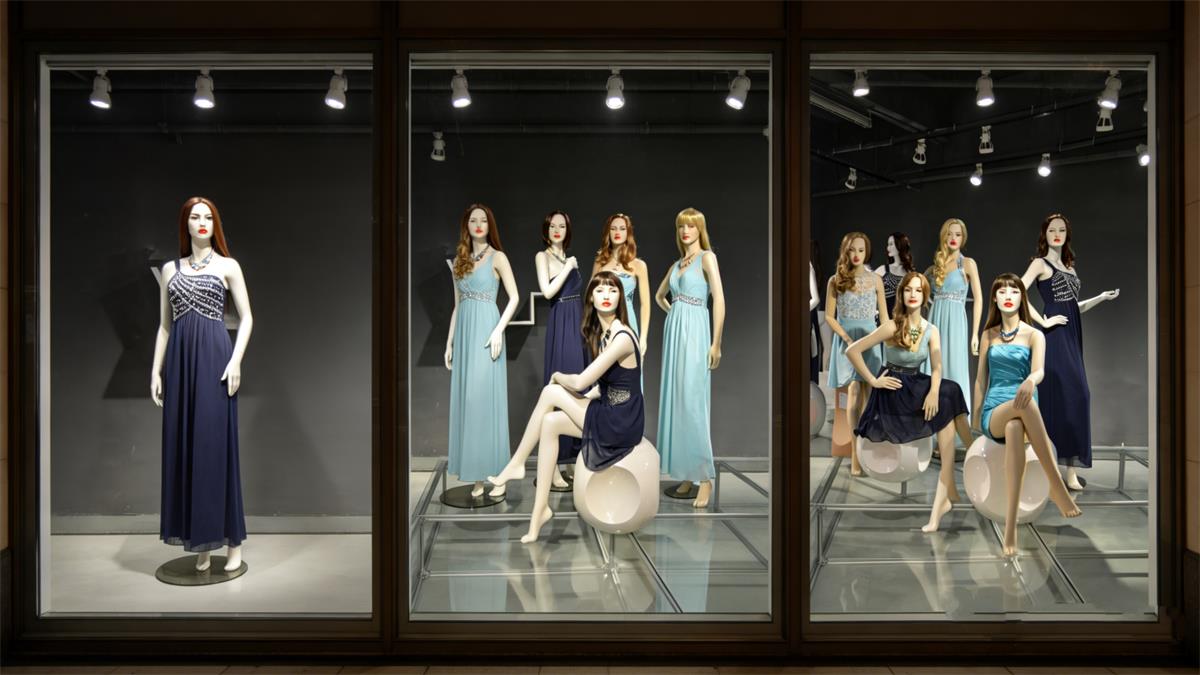
Buy the number of forms the window can dress properly, then group them around a single focal point instead of spacing them evenly. The table below is a working count for a boutique window with one glass frontage and an eye height of roughly five feet four inches.
| Window width | Forms to plan | Arrangement | Notes |
|---|---|---|---|
| Up to 6 ft / 1.8 m | 1 or 2 | One hero form at the focal point, one smaller form in front | One well-dressed form beats two competing looks in a narrow glass |
| 6 to 12 ft / 1.8 to 3.6 m | 2 or 3 | Triangle, tallest on the outer edge | Put the most detailed look on the tallest form, since it reads first |
| 12 to 15 ft / 3.6 to 4.5 m | 3 or 4 | Two clusters with one anchor prop between them | Two clusters read as depth. One long line reads as a queue |
| Over 15 ft / 4.5 m | 5 to 6 | Two or three clusters with a repeated motif | Repeat a motif rather than adding a new prop each time |
Keep every focal detail between 48 and 60 inches above the floor, which is where a collar, a scarf, a hat or a held object reads from the pavement. If the range is mostly folded, high-value or hard to fit on a full form, dress forms do the same job in less depth. Browse female mannequins, male mannequins, kids mannequins and dress forms to see how the categories sit inside a group, and check the mannequin size chart before you assume your existing forms fit your customer.
How do you light a November window after the clocks change?
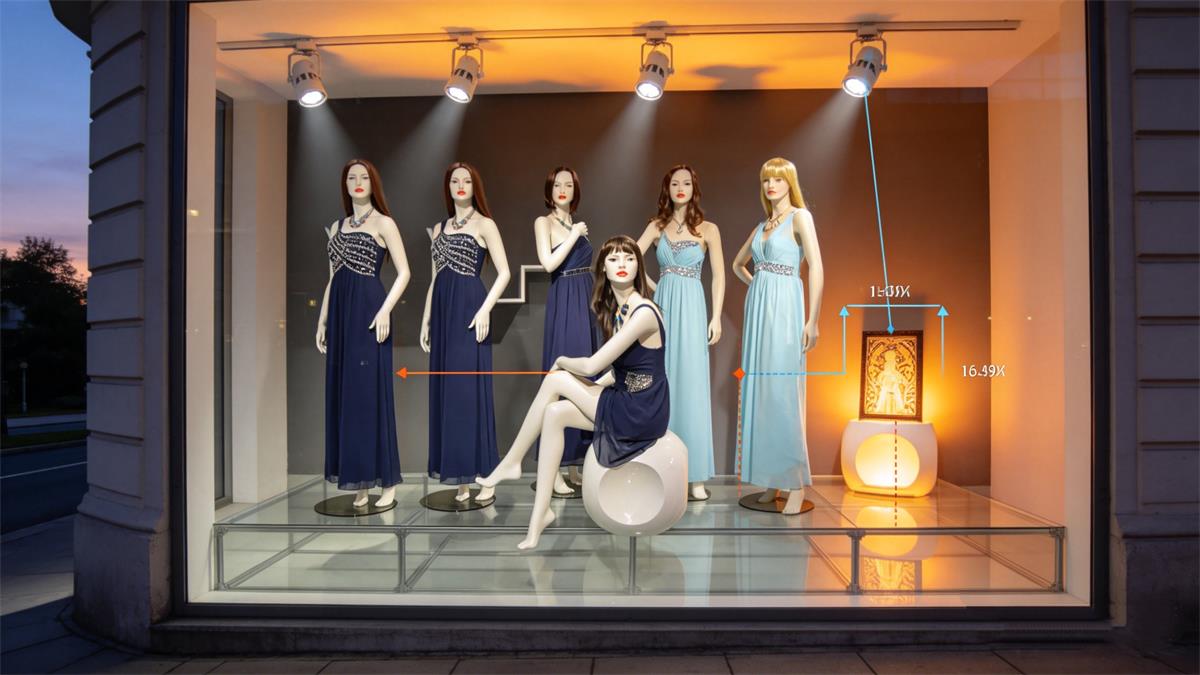
Treat light as three separate jobs rather than one switch, because in November most of the people who see your window are seeing it on the way home in the dark. An ambient layer lifts the scene, an accent layer aims at the product rather than the wall, and one feature element reads from twenty feet away. Daylight does the work until about 5pm; after that the window is a light box.
| Layer | Job | Working target | How to check it |
|---|---|---|---|
| Ambient wash | Lift the whole scene without flattening texture | Warm, around 2700K to 3000K, run below the accent layer rather than at full power | Stand across the street at 6pm and confirm the scene is readable but not washed out |
| Accent spots | Put light on the product, not the backdrop | One spot per focal form, aimed at the garment from above and slightly to the side | Look for shadow inside the folds. Flat light on knitwear loses the texture you are selling |
| Feature element | Give the window one thing visible from far away | A lit prop, a warm backdrop panel or a single bright object at the back of the set | Walk the far side of the street. If you cannot name the focal point, it is not reading |
Run the after-dark test twice
Check the window after dark on install day and again in the last week of November, when the props have moved and the weather has changed. Most November windows fail not because the lighting is wrong but because nobody looked at the window at the hour the audience walks past it. The three-layer approach in our window display lighting guide applies with one seasonal adjustment: push the accent layer higher than in summer, because ambient daylight no longer helps.
Which colors make a Thanksgiving window that is not a cliché?
Build the palette as a ratio, with warm mid-tones carrying the middle band and one cooler accent to stop the whole window turning into a wall of brown. Harvest color fails when everything sits in the same narrow band of orange, because nothing separates and the eye has nowhere to land.
| Layer | Share of the window | Color direction | Material direction |
|---|---|---|---|
| Base | About 60% | Warm neutral, oatmeal, soft cream, pale gray | Matte painted panel, natural board, plain wall |
| Mid | About 30% | Terracotta, rust, olive, mustard, warm brown | Wool, felt, raw wood, matte ceramic, dried stems |
| Accent | About 10% | One cool or deep note: slate blue, forest green, deep plum | Glass, metal, velvet ribbon, one painted object |
Two adjustments keep the palette working into December. Keep the cool accent small and deliberate, because that single note makes the warm tones read as chosen rather than accidental. And do not let red and green arrive in November: the moment holiday red enters the mid band, the window is a Christmas window and the December handover has nowhere to go.
How do you hand a Thanksgiving window over to Black Friday?
Build the window in three layers so the handover is a swap rather than a rebuild. The base layer, meaning platform, backdrop and lighting, holds for the whole period. The middle layer, props and the merchandise family on show, changes once. The front layer, price cards and the accessory on the hero form, changes weekly and costs almost nothing. A window built as one finished picture has no layers, so every change becomes a rebuild.
| Layer | Lifespan | What changes | Cost to change |
|---|---|---|---|
| Base | 4 to 5 weeks, late October to late November | Nothing | None |
| Middle | Once, around November 23 | Props and the merchandise family | Moderate |
| Front | Weekly | Price cards, small props, hero accessory | Very low |
The handover window is narrow, so plan it now. Keep the Thanksgiving build fully intact through Wednesday, November 25, then swap only the front layer for a single legible price message before Black Friday on November 27. The Thanksgiving atmosphere can survive behind that message for a few days, which keeps the store looking deliberate rather than stripped. The full mechanics of that weekend, including the door-to-till route and what to measure, sit in our Black Friday visual merchandising guide, and the wider seasonal lead times are mapped in the holiday visual merchandising calendar.
How do you know the Thanksgiving window worked?
Measure against the week before the install, not against the holiday weekend, because comparing early November to Black Friday tells you nothing. Six numbers cover it, and four need nothing more than a tally sheet at the till.
| What to track | How to capture it | What a good result looks like | What a miss tells you |
|---|---|---|---|
| Stop rate | Tally people who slow or stop at the glass across two 30 minute windows | Higher than the pre-install week | The window is not answering a question the passerby has |
| Entry count | Door counter or manual tally, install week versus prior week | Above the pre-install week | The window promised something the shop floor does not deliver |
| Fitting room use | Hangers taken into fitting rooms | Above a normal week | The forms show looks customers cannot find on the rail |
| Category sell-through | Units sold divided by units received, on the layered category | The layering category moves fastest | The display and the stock plan disagree |
| Average transaction value | Sales divided by transactions | Up against the same weeks last year | The window is pushing one item rather than a look |
| Layered outfit rate | Count of transactions containing two or more of the layered pieces | Rising across November | The styling is not teaching the customer how to buy |
The layered outfit rate is the metric specific to this window, because selling a wardrobe rather than a garment is the whole commercial argument for a Thanksgiving build. If entry counts rise but nobody buys in multiples, the fix sits with the form in the glass rather than with the lighting.
What mistakes cost the most in November?
Most November windows fail for a short list of repeatable reasons, and each one has a low-cost fix.
Leaving Halloween up into the second week. Orange props in mid-November cost you the only weeks where a customer is shopping for herself.
Building a banner instead of a window. A message-led window works only when the message is small and the product is the hero.
Installing in mid-November. The build has to be finished before the week that 70% of shoppers say they will shop.
Letting the window go dark at 5pm. In November the after-dark version is the real version.
Telegraphing December too early. Holiday red in the mid palette leaves the December handover nothing to announce.
Ready to plan your Thanksgiving window?
Start with a neutral base in the last week of October, one hero form dressed in a complete layered outfit, a warm three-layer light setup aimed at the product, and a calendar that holds the Black Friday front-layer swap. Browse female mannequins, male mannequins, kids mannequins and dress forms to fill the gaps in your grouping, look at display props for the base-layer pieces that carry through to December, and contact the team for a second opinion on a layout before install week.
For the adjacent nodes in this cluster, the Halloween retail display guide covers the build that comes down before this one goes up, the Christmas window display guide covers what replaces the Thanksgiving layer, and the fall window display guide covers the October handover. For styling rather than calendar, the mannequin styling walkthrough covers layering and proportion, and the dress form display guide covers lower-depth options, and the complete window and in-store display guide is the wider bank of concepts.
About the Author
Brook Chen is a Visual Merchandising Specialist at awmannequins.com. With over 8 years of experience designing window and in-store displays for retail brands across the US, Canada, and Australia, she helps boutiques and stores translate seasonal concepts into store-ready merchandising.
Frequently Asked Questions
When should you put up a Thanksgiving window display?
The last days of October or the first week of November, with November 1 treated as a hard reset day rather than a slow fade. Halloween has to come out completely first, and the Thanksgiving build should be finished and photographed before the second week of November, because 70% of holiday shoppers plan to shop during Thanksgiving week and the display has to already be working when they arrive.
How long should a Thanksgiving window display stay up?
Roughly four weeks, from the first week of November through Wednesday, November 25. After that, swap only the front layer for a single price message so the window can carry Black Friday on November 27, then replace the build that weekend. A harvest scene still in the glass on December 5 reads as a store that has stopped paying attention.
What colors should a Thanksgiving window display use?
Warm neutrals across about 60% of the surface, terracotta, rust, olive or mustard across roughly 30%, and one cool or deep accent on the remaining 10%. The ratio is what keeps the window from becoming a single block of orange, and the small cool note is what makes the warm tones read as a deliberate palette rather than a default one.
Do you need mannequins for a Thanksgiving window display?
Not always, but a boutique window almost always benefits from at least one form, because the job of the November window is selling a layered wardrobe rather than showing a decoration. One well-dressed form in a complete outfit, with a second in the same look a layer lighter, answers both questions a November shopper brings inside: what to wear now, and what to wear to the gathering.
How do you transition a Thanksgiving window to Black Friday?
Build in three layers so the change is a swap rather than a rebuild. Keep the base, meaning platform, backdrop and lighting, untouched all month, change the middle layer once around November 23, and swap only the front layer, price cards and small props, for a single legible price message before Black Friday. The Thanksgiving atmosphere can stay behind that message for a few days.