Tel: +86-0769-33218711
E-Mail: info@ysydisplay.com
Add: A1#807, Tianan cyber building, Huangjin Road, Nancheng, Dongguan, China 523000.


Longevity
Art Wing designs and manufactures custom display mannequins. This page is about the part of sustainability we can control from the factory: how long a figure lasts, and how easily the parts that wear can be replaced when they do.
Service life10+ yearsFibreglass body, indoor retail use
Refinish cycleEvery 2–3 yearsSurface wear, not structural failure
Replaceable partsHead, arms, base, finishSwapped without touching the body
Packed volume0.2 CBM114 × 44 × 38 cm, body split from base
Definition
Three measurable things, and nothing else. A figure that lasts ten years instead of two. A figure whose arm can be replaced in a workshop instead of being thrown away with the body. A figure whose surface can be repainted when it scuffs, rather than retired because it looks tired.
Materials matter, but they are not the whole answer. A recycled-content figure that is thrown out after one season is worse than a virgin-material figure whose surface is recoated four times. Longevity is the variable you can actually control, and it is the one this page is about.
| Claim | What has to be true | How you check it |
|---|---|---|
| Durable | The body survives handling, storage and transport without cracking or deforming. | Ten years of indoor use; look at the seams and the base socket, not the paint. |
| Repairable | A damaged arm, neck or base can be replaced without replacing the torso, using standard fittings. | Ask whether parts are sold separately, and whether the fittings are standard across the range. |
| Refinishable | A scuffed surface can be sanded and repainted to match the original. | Ask for the paint specification and the touch-up procedure, not just the colour name. |
Diagnosis
Most mannequins are not retired because they broke. They are retired because a store changed format, a season changed palette, or a surface got scuffed and nobody had a repair route. Fixing those three causes is cheaper than buying new figures, and it is where most of the waste sits.
| Cause | What usually happens | What to do instead | What it saves |
|---|---|---|---|
| Surface wear | Paint scuffs at the hip and shoulder from handling; the figure is pulled from the floor. | Sand, prime and repaint. Two to three years between finishes is normal in a busy store. | The whole figure, and the tooling that made it. |
| Broken arm or base | A snapped wrist or a cracked base disc condemns an otherwise perfect torso. | Order the arm or base as a spare part and refit it on site. | Seventy to eighty per cent of the unit. |
| Format change | The store moves from seated to standing groups, so the whole set is replaced. | Specify modular fittings from the start so poses can be rebuilt from the same bodies. | The bodies, and the visual continuity of the range. |
| Freight damage | Figures arrive chipped because they were shipped assembled and loose. | Ship split: body, base and arms packed separately in moulded cradles. | Replacement shipments, and the volume you pay for. |
None of these needs a factory. They need a decision at specification stage and a local finisher who can follow it. We supply the parts and the paint specification; the work happens where the figures are.
Process
We do not run a repair or refurbishment service, and we do not trade in second-hand figures. What we do is make replacement practical: standard fittings, parts that can be reordered from the original mould, and a finish system that can be taken back and recoated. The sequence below is what a local finisher would follow; none of it needs the original tooling.
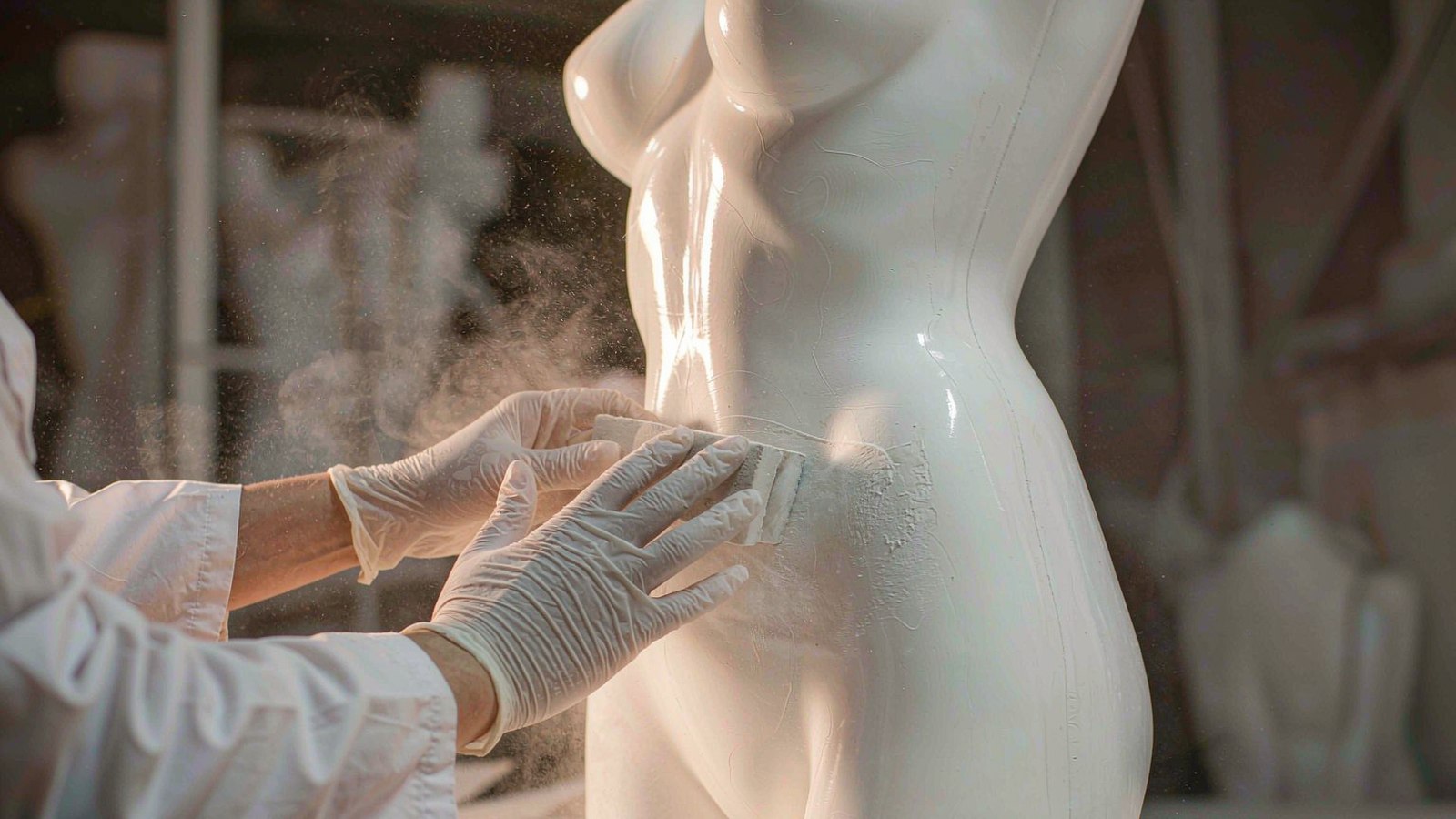
Assess. Check the seam lines, the base socket and the neck fitting. Cracks that run across a seam are structural; scuffs and chips are cosmetic.
Strip the hardware. Remove arms, base and any fittings so the body can be worked on flat.
Sand back. Take the damaged area down to a sound substrate, feathering the edge so the repair does not show under a gloss coat.
Fill and fair. Repair chips and small holes, then sand flush. This is where a rushed repair shows: skipped filling reads as a shadow line under light.
Prime and topcoat. Two coats, matching the original sheen. Matte, satin and gloss need different coverage and different drying times.
Cure and inspect. Full cure before the figure goes back on the floor, then a check under raking light for dust and runs.
What can be put right: surface damage, chipped edges, snapped arms and wrists, cracked base discs, loose neck fittings. What cannot: a body that has deformed under heat, or a torso cracked through the waist. On those, the honest answer is a new figure — and we would rather say so than describe a repair that will fail.
Design
Modularity only helps if the fittings are standard across a range and the parts are available years later. On our figures, four things can be changed without touching the body, which is what turns a single purchase into a system you can restyle for a decade.
Because every figure is made to order, the fittings get specified rather than inherited from a catalogue. That is the moment to fix the things that decide service life: one neck fitting across the range, arms that can be reordered on their own, a base material matched to the actual floor, and a finish that can be recoated instead of colour-matched by eye.
| Part | Options | What swapping it lets you do |
|---|---|---|
| Head and neck | Headless with a neck cap, egg-shaped head, sculpted head | Change the level of abstraction without changing the body, so one torso serves several store formats. |
| Arms | Straight, bent, articulated wooden arms, or no arms | Rebuild a pose for a new season instead of buying figures that only work standing still. |
| Base | Tempered glass disc, iron disc, iron square, tripod, solid oak | Match a new floor finish or a heavier foot traffic area without replacing the figure. |
| Finish | Six standard colours held in stock, others to order | Repaint a whole set to a new palette, keeping the silhouettes the brand is recognised by. |
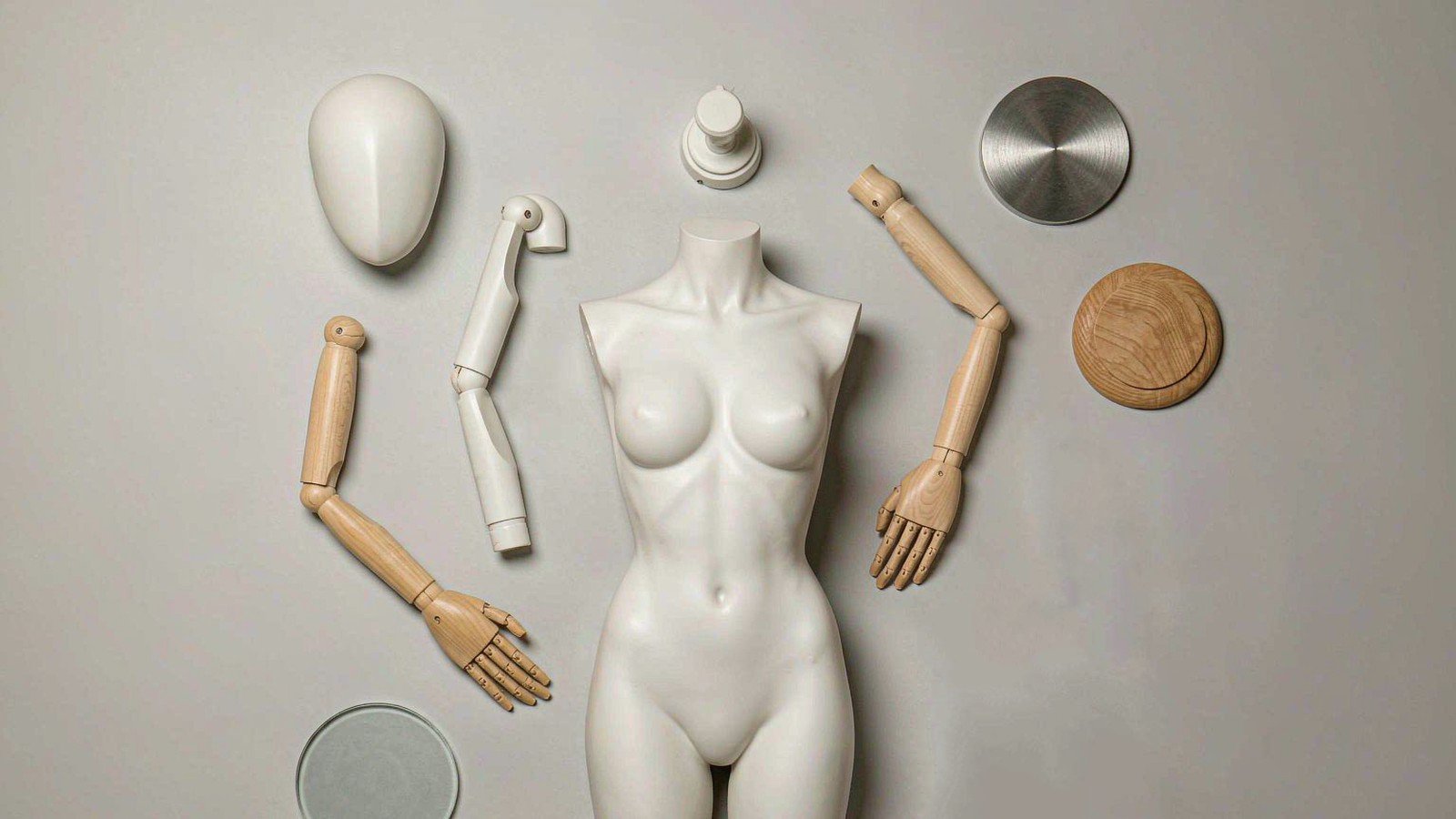
The base system is worth a separate look, because it is the part most often replaced for the wrong reason. A cracked disc is a base problem, not a mannequin problem. Bases and stands covers which material suits which floor and which pose.
Logistics
For an imported display programme, the sea freight often carries more embodied carbon than the figure itself. Volume, not weight, is what you pay for, so packing flat and shipping split is the single largest lever most brands have.
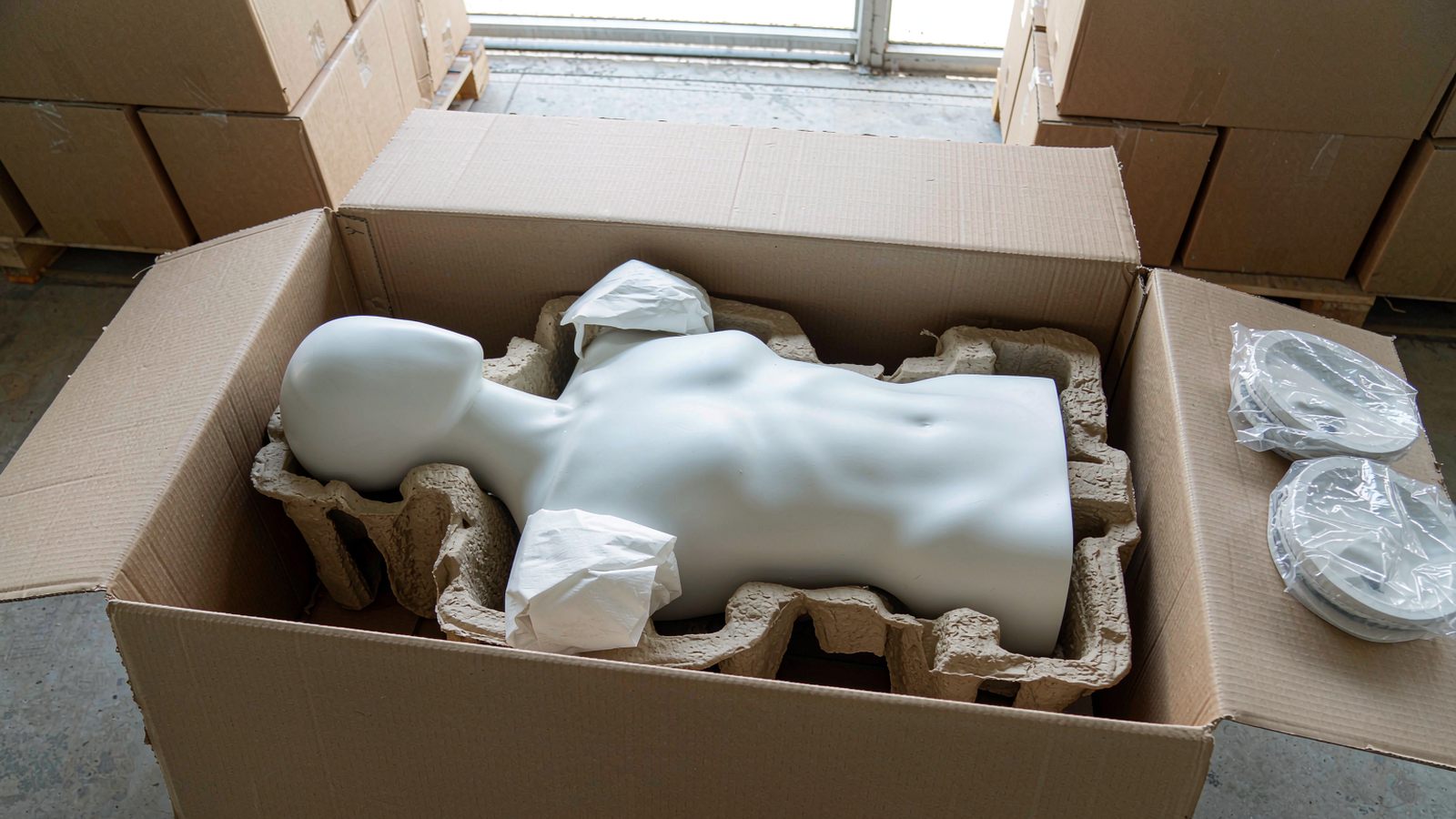
| Approach | Packed volume per unit | Effect on a container |
|---|---|---|
| Shipped assembled, one carton per figure | Higher: the figure sets the carton height and the arms set the width | Fewer units per container, more containers per order |
| Split: body, base and arms packed separately | 0.2 CBM, 114 × 44 × 38 cm | More units per container, and bases can be nested |
We will give you the packed volume and the container loading for a specific order rather than a generic figure, because it changes with the pose and the base. Ask for it with your order quantity and we will work it out against the actual carton sizes.
Boundaries
Fibreglass is a thermoset composite. It does not biodegrade, and it is not straightforward to recycle back into new figures. If a supplier tells you otherwise, ask them for the recycling route and the name of the facility.
We also do not run a refurbishment service or trade second-hand figures — this page describes how the product is built, not a service we sell. What we can defend is a longer service life, replaceable parts, and tooling that stays available for reorders. That is a real reduction in waste per season, but it is not the same as a closed-loop material, and we would rather say so than let the word sustainable carry a claim it cannot support.
Multi-store
The economics change at scale. A single store can repaint a figure when it looks tired; a network of forty needs a policy, or the refresh never happens because nobody owns it.
| Element | What to specify | Why it matters at scale |
|---|---|---|
| Standard fittings | One neck and shoulder fitting across the range, so arms are interchangeable between styles | One spare arm covers several figure types instead of one |
| Spare ratio | Hold five per cent of the fleet in arms and bases | Most damage is a part, not a body; a small spare pool prevents whole-figure orders |
| Batch refinish | Refinish a store cluster each year rather than the whole estate at once | Spreads cost, keeps the visual refresh continuous, and avoids a warehouse full of retired figures |
| Colour control | Keep the paint specification with the store manual, not with the supplier | Refinished figures still match the ones that were not refinished |
For the production side of this, how our mannequins are made covers the mould, casting and finishing steps, including where a repair is possible and where it is not. If you are specifying a new range, visual merchandising guides covers sizing and grouping decisions that affect how long a set stays usable.
Style, pose, finish, base and quantity per store. We quote against the actual mould position rather than a catalogue price, and we will tell you which parts are worth holding as spares so a single damaged arm does not take a whole figure off the floor.
CONTACT US
ART WING Display Mannequin, a China manufacturer of high-end-mid mannequins.
We dedicated to innovative design and focus on producing high-quality display production.
QUICK LINKS
PRODUCTS
ABOUT ART WING
SERVICE

Tel: +86-0769-33218711
E-Mail: info@ysydisplay.com
Add: A1#807, Tianan cyber building, Huangjin Road, Nancheng, Dongguan, China 523000.
Copyright © 2026 DongGuan Art Wing Display Co., Ltd | All Rights Reserved
Hello, please leave your name and email here before chat online so that we won't miss your message and contact you smoothly.