Tel: +86-0769-33218711
E-Mail: info@ysydisplay.com
Add: A1#807, Tianan cyber building, Huangjin Road, Nancheng, Dongguan, China 523000.


Order shapes
We do not publish client names. Everything on this page describes the shape of the order and the numbers behind it: how many figures, in what poses, on what base, in what time. That is the part a buyer can actually compare against their own brief.
Each of the four below turns on one decision that, if you get it wrong at the start, cannot be fixed later. Those decisions are named.
| Order shape | Typical volume | The decision that decides it |
|---|---|---|
| Multi-store rollout | 40–60 doors × 4–6 figures | One neck fitting and one base across the whole range, fixed before the first mould is cut |
| Single boutique, custom pose | 4–10 figures, one pose | The one dimension the floor fixes — usually seat height or window base height |
| Seasonal OEM for an agency | 20–40 figures, one shipment | The install date, worked backwards through production and sea freight |
| Kids range | 3 ages × 3–4 poses | Whether the proportions come from child anthropometry or from scaling the adult body |
01 · Multi-store retail
A chain moving into a new store format needs the same six poses in every location. Ordered store by store, the fourth city never quite matches the first, and nobody can tell whether it is the paint, the light or the pose. Ordered as one brief, the constraint moves from the figure to the fittings.
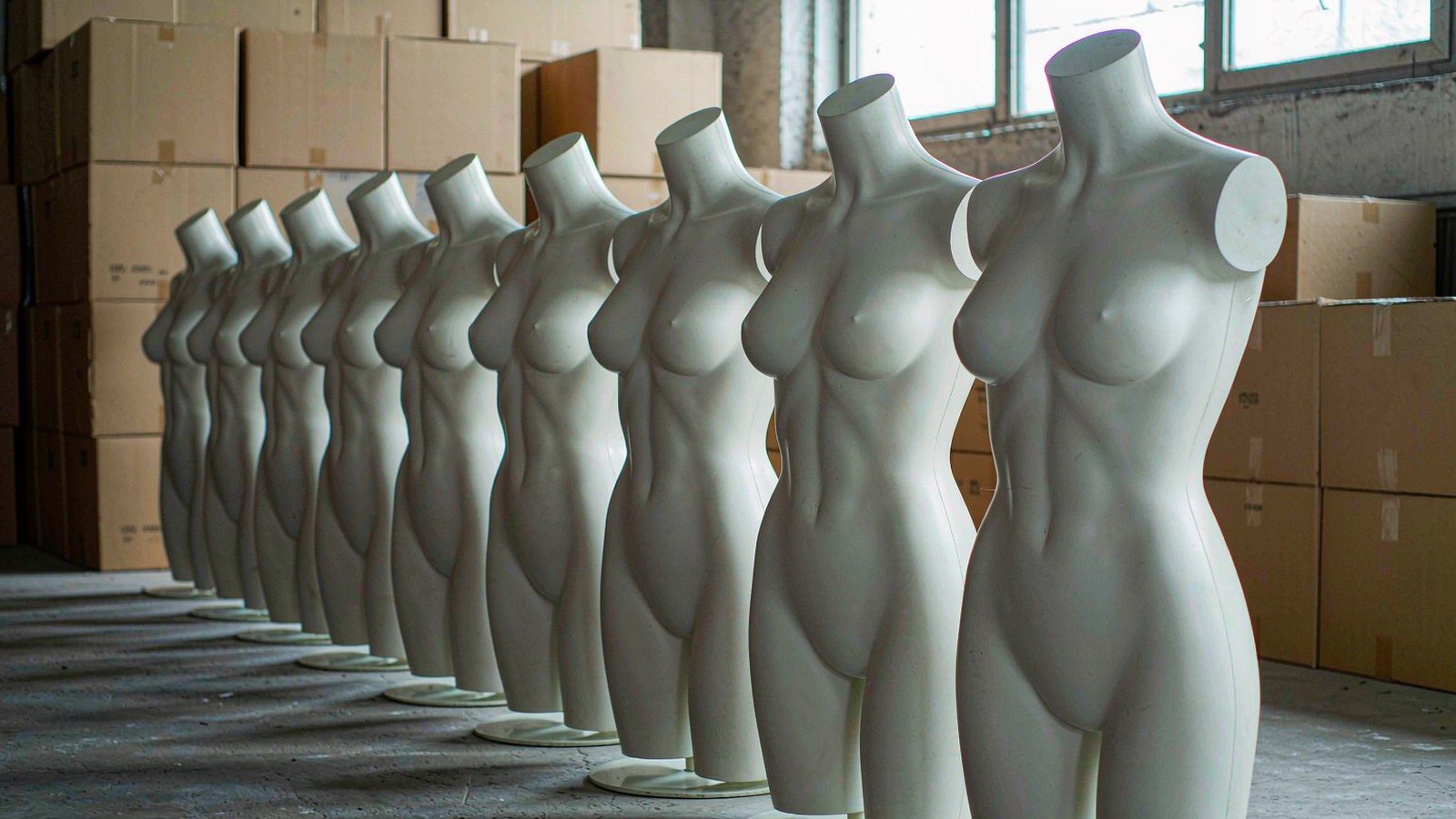
| Order | 40–60 stores × 4–6 figures, released in 3–4 batches |
| Figures | Four standing, one seated, one three-quarter turn; headless with neck cap |
| Material | FRP, adult female |
| Finish | Matte bone white, one batch colour approved on a sprayed panel |
| Bases | Round iron disc, identical across all units |
| Lead time | 3–4 weeks production per batch, plus 4–6 weeks sea freight |
| Packing | 0.2 CBM per unit, 114 × 44 × 38 cm, body split from base |
What makes it work is deciding the fittings before tooling: one neck socket, one base thread, one paint specification across the range. After that, a store can reorder a single arm. The fourth batch can match the first without a second colour approval, which is the cost nobody budgets for on a rollout.
02 · Single store
A boutique wants the figure from a magazine spread — seated, one arm across the knee, head turned. Catalogue seated poses read too formal for a small floor. The order is small enough that the tooling has to be justified by the pose alone, so the pose has to be settled before anything is cut.
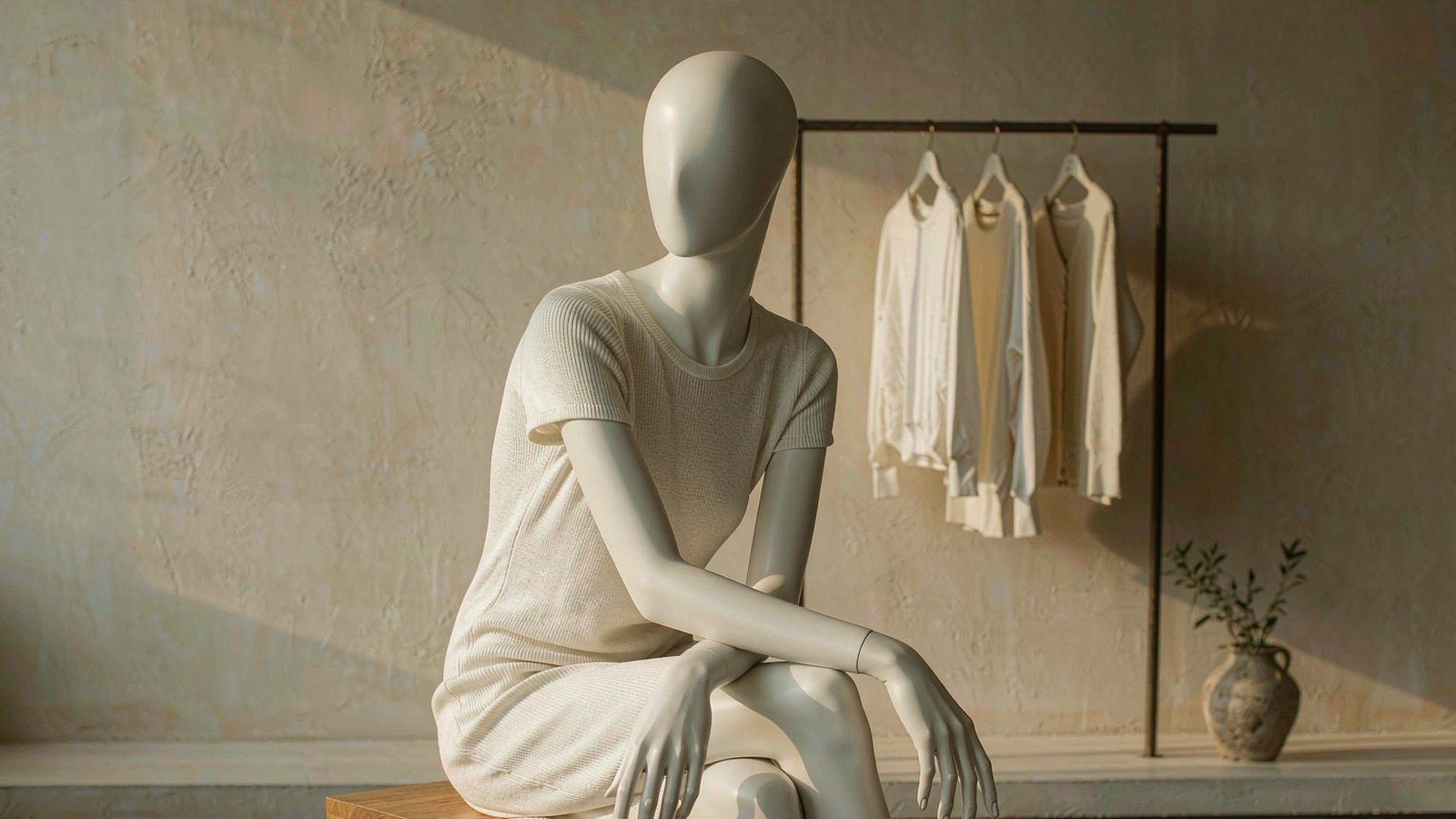
| Order | 4–10 figures, one pose |
| Figures | One custom seated pose, headless, neck cap finished to the same standard as a catalogue figure |
| Material | FRP |
| Finish | Warm white, satin |
| Bases | Low timber block, height set by the window base |
| Lead time | About 3 weeks for the pose sample, then 2 weeks production |
| Packing | Individual timber crate, non-standard dimensions |
The pose is modelled from two photographs plus one dimension we insist on: the height the figure will actually sit at, because the window base is fixed and a centimetre there changes the whole silhouette. A quarter-scale 3D print settles the proportion question before the mould is committed. Skipping that step is what makes small custom orders go wrong.
03 · Seasonal OEM
A display agency builds a Christmas campaign for a department store. They specify the finish and the date; the figures, the packing and the container are ours. They never handle the product, which means the only failure they can absorb is a missed install date — so the date is the brief.

| Order | 20–40 figures, single shipment |
| Figures | Standing, mixed male and female, headless |
| Material | FRP |
| Finish | Metallic gold, approved as a sprayed panel against the store's own sample |
| Bases | Round iron disc, black |
| Lead time | 4 weeks production, dated backwards from the install, not from the order |
| Packing | Full container, 40HQ, bases crated separately |
Metallic and gloss finishes are matched within a tolerance, by eye, on a physical panel. A hex code will not do it: the same gold reads warm under a 3000K spotlight and green under a cool one. Approving the panel under the store's own lighting is the step that stops thirty figures from arriving as three slightly different colours.
04 · Kids range
A back-to-school window needs children at three ages that still read as one group on the floor. Child figures are where proportion goes wrong most often, because the quickest route — scaling the adult body down — produces small adults rather than children.
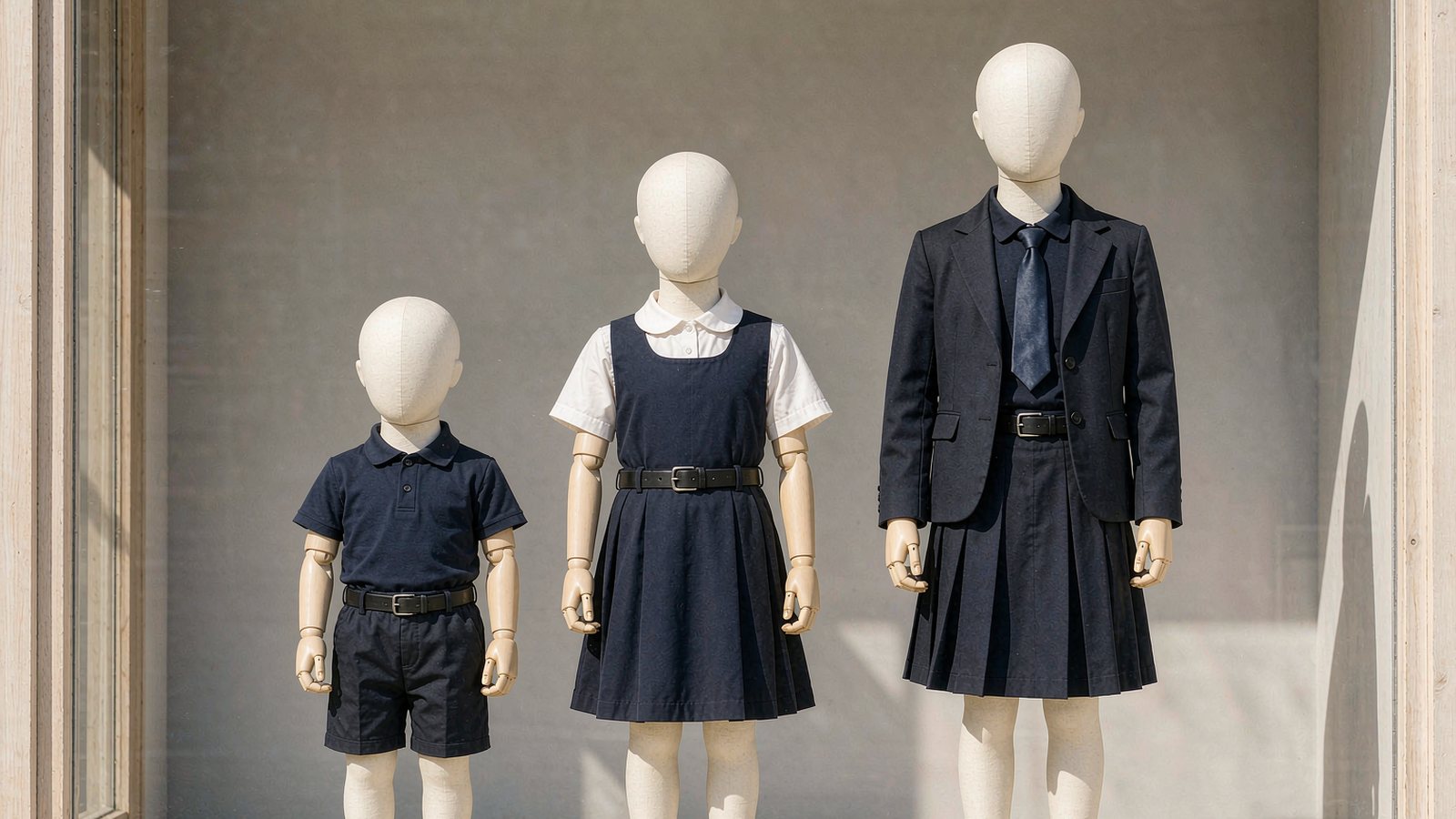
| Order | 3 ages × 3–4 poses |
| Figures | Roughly 5, 8 and 12 years; headless with neck cap |
| Material | FRP; articulated wooden arms available on any figure in the set |
| Finish | Matte white or matched skin tone |
| Bases | Low plinth for the smallest, so the three read at one eye level |
| Lead time | 3 weeks, three ages in one batch |
| Packing | Cartons split by age, not by pose |
Head-to-body ratio is the whole difference: a child at five carries a much larger head relative to the body than one at twelve, and the shoulder-to-hip ratio changes with it. Modelling the three ages from child anthropometric data rather than scaling one body is what keeps the group looking like siblings instead of a size run.
What we need from you
We quote against a mould position, not a catalogue price, so the first reply needs enough to place the order on a specific tool. Four items get there:
Pose and quantityStanding, seated or a custom pose, and how many per location. A photograph of the pose is more useful than a description.
The fixed dimensionWindow base height, ceiling height, plinth height — whatever the floor plan has already decided. This is the number that constrains everything else.
FinishA physical sample if you have one, or the reference brand and material. Matte, satin and gloss read differently under retail lighting, and metallic cannot be specified by code.
Deadline and destinationThe date the figures have to be standing in the window, and the port. We work backwards from the install date, not from the order date.
Pose, quantity per store, the fixed dimension from the floor plan, and the date it has to be installed. We will come back with the tool position, the lead time against your date, and which parts are worth holding as spares.
CONTACT US
ART WING Display Mannequin, a China manufacturer of high-end-mid mannequins.
We dedicated to innovative design and focus on producing high-quality display production.
QUICK LINKS
PRODUCTS
ABOUT ART WING
SERVICE

Tel: +86-0769-33218711
E-Mail: info@ysydisplay.com
Add: A1#807, Tianan cyber building, Huangjin Road, Nancheng, Dongguan, China 523000.
Copyright © 2026 DongGuan Art Wing Display Co., Ltd | All Rights Reserved
Hello, please leave your name and email here before chat online so that we won't miss your message and contact you smoothly.