

Christmas Window Display Ideas: How to Build a Retail Window That Sells in December
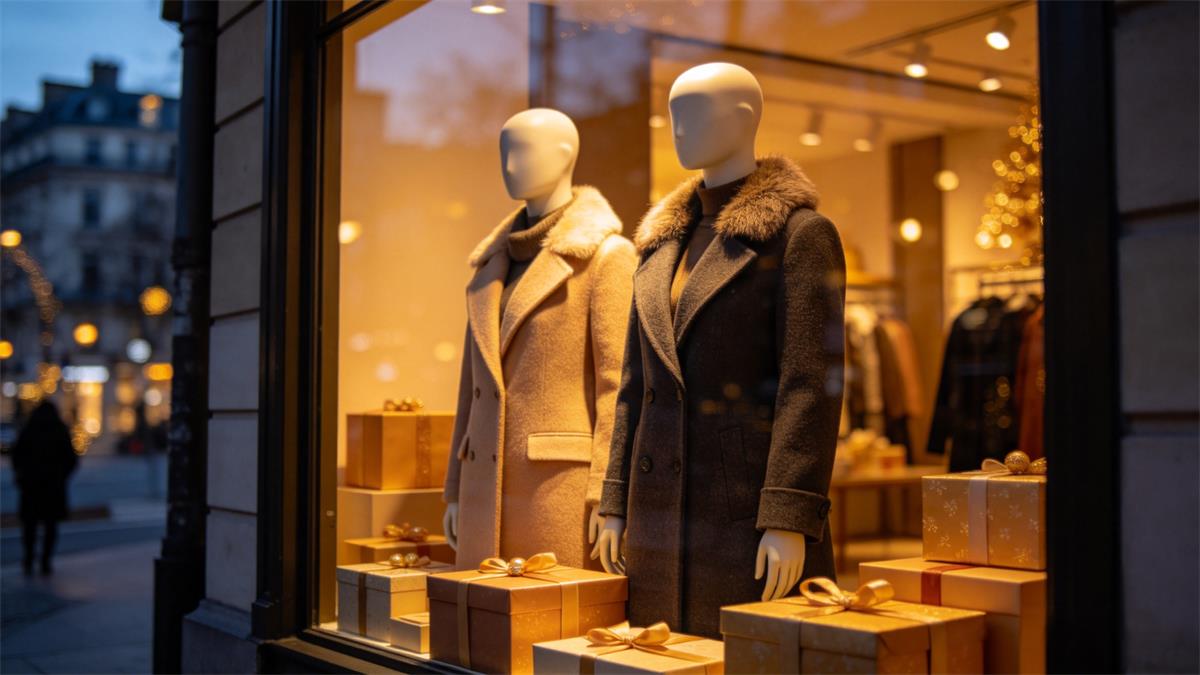
Christmas window display ideas work when they do one job clearly: tell a shopper walking past what to buy, for whom, and why today. The reliable way to get there is to pick a single concept you can describe in five words, put the focal point between 48 and 60 inches above the sidewalk, light it warm at 2700 to 3000K, and give the build six to seven weeks of lead time. This guide covers the concept families that suit different store types, window layouts by depth and width, how many forms to use and at what height, the lighting layers that keep red and green merchandise from turning muddy, budget bands, a week-by-week build calendar for the 2026 season, and a simple way to measure whether the window paid for itself. For the wider display framework behind these choices, start with the window and in-store display ideas guide.
What makes a December window different from the rest of the year?
A December window runs longer and carries more weight than any other display you will build. NRF defines the holiday season as November 1 through December 31, and its November 2025 forecast put November to December sales at between $1.01 trillion and $1.02 trillion, up 3.7% to 4.2% over the $976.1 billion of 2024 (NRF, 2025). That is two full months of trading compressed into one window.
Three things follow from that. The display has to stay interesting for five or six weeks rather than five days, so it needs a layer you can change without rebuilding. It has to work in daylight, after dark, and in bad weather, because December gives you the shortest days of the year. And it has to sell gifting rather than self-purchase, which changes what you put in a form's hands.
The practical consequence is that December rewards structure over spectacle. A window built on one clear idea with a changeable front layer will outperform a complicated scene that looks tired by week three.
When should the Christmas window go up in 2026?
Earlier than most independents plan for. Christmas 2026 falls on Friday, December 25, which pulls the last heavy shopping weekend forward and leaves a short runway after Super Saturday. NRF's 2026 annual forecast has full-year retail sales growing 4.4% to $5.6 trillion (NRF, 2026), so the window is being built into a market that is still expanding rather than contracting. Work backwards from the dates in this table.
| Date in 2026 | Milestone | What it means for the window |
|---|---|---|
| November 1 | Start of the NRF holiday season | Window should already read as seasonal, not transitional |
| November 26 | Thanksgiving | Last quiet day to finish any fixes |
| November 27 | Black Friday | Window must read as gifting, not discount signage |
| November 30 | Cyber Monday | Online pickup traffic peaks; keep the entrance clear |
| December 19 | Super Saturday | Peak footfall; the refresh layer goes in this week |
| December 25 | Christmas Day | Display has done its job |
| December 26 to 30 | Teardown window | Strip within three days; a half-stripped window looks worse than an empty one |
Lock the concept in the week of October 19 and install in the week of November 16, so the window is live for a full selling week before Black Friday. Shopify's retail guidance puts front window refreshes at every two to three weeks, and faster during peak promo periods (Shopify, updated 2026), which means one refresh around November 30 and a second around December 14.
If you are carrying a look across from autumn, the handoff matters more than the theme. Our fall window display ideas piece covers the platform structure that makes a swap inexpensive, and the holiday visual merchandising calendar maps every node of the year to its lead time.
Which Christmas window display ideas fit your store?
Most good Christmas window display ideas fall into three families. Pick one and commit, because a window that tries to be all three reads as clutter from across the street.
| Concept family | The job it does | Best for | Build effort | Risk |
|---|---|---|---|---|
| The gift vignette | Shows a finished gift, wrapped and ready | Boutiques, gift shops, accessories | Low to medium | Can look like a stockroom if props crowd the form |
| The winter scene | Sells a feeling, builds dwell time | Apparel, home, department stores | High | Expensive, and it dates quickly after December 26 |
| The single hero | One product, one message, read in two seconds | Small windows, single-category shops | Low | Boring by week three unless the front layer changes |
The gift vignette is the safest starting point for an independent because it answers the shopper's actual question, which is "what do I buy for her?" A wrapped box in a form's hands does more work than another string of lights.
How do you lay out a Christmas window?
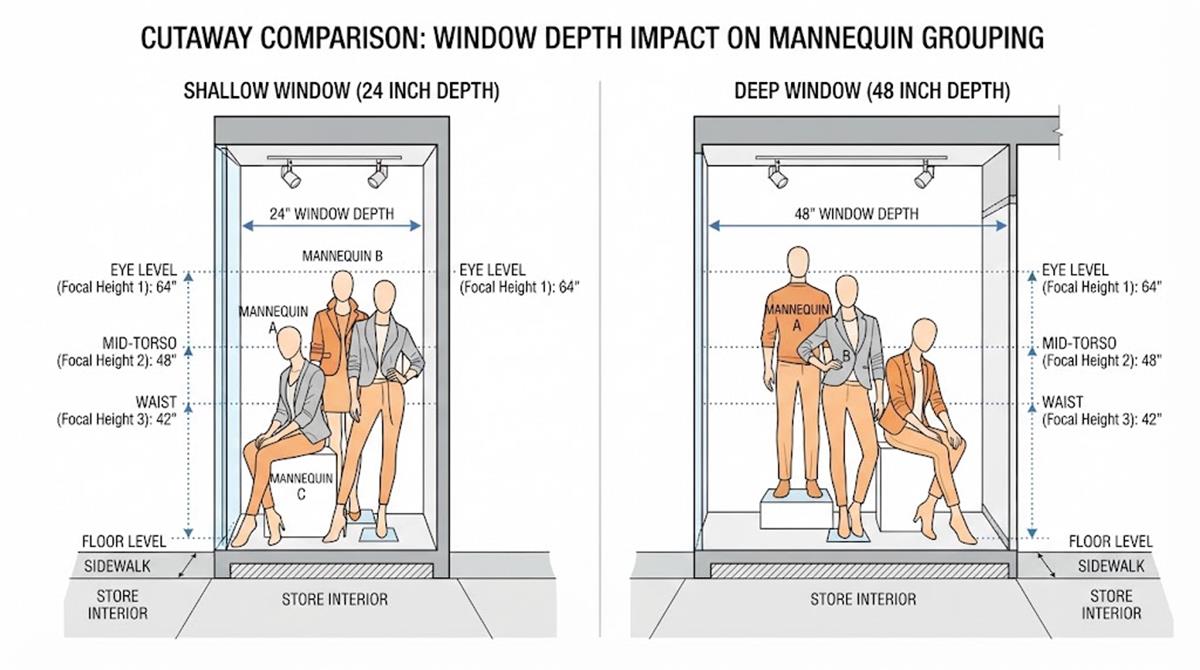
Layout follows the glass, not the idea. Measure depth and width before you sketch anything, because the same concept fails in a shallow window and a deep one.
| Window type | Layout move | Forms | Focal height | Common mistake |
|---|---|---|---|---|
| Shallow, under 30 in deep | Build flat, use the back wall as the backdrop | 1 to 2 | 52 to 60 in | Props with depth that block the walkway view |
| Standard, 30 to 48 in deep | Triangle composition, staggered depth | 2 to 3 | 48 to 56 in | Three forms in a straight line at equal height |
| Deep, over 48 in | Foreground, midground, backdrop planes | 3 | 48 to 60 in | Empty middle ground that makes the window look unfinished |
| Corner or two-sided | Check the sightline from the main approach | 2 | 52 to 60 in | Hero only visible from the quieter street |
| Wide, over 10 ft | One hero plus generous negative space | 2 to 4 | 48 to 60 in | Filling the full width until nothing stands out |
Small shops often assume they need less, when they need more focus. A narrow window with one well-lit form and a strong backdrop beats a crowded one, and the same principle is covered in more depth in our boutique window display ideas guide.
What should the mannequins and dress forms be doing?
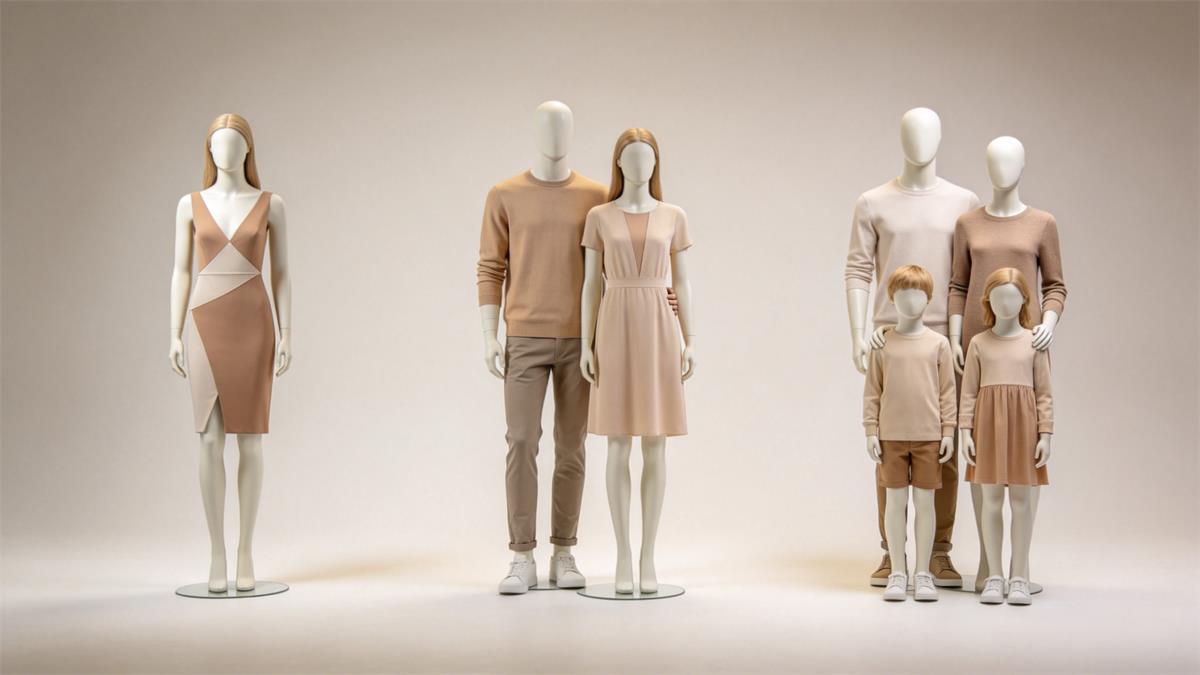
Forms carry the garment and the gesture. Group them by the buying situation you are selling into, not by what fills the space.
| Grouping | Merchandise it sells | Form height on the platform | Notes |
|---|---|---|---|
| Single female form | Outerwear, party dressing, one gift idea | Eye level at 52 to 56 in | Add a wrapped box or bag to signal gifting |
| Male and female pair | Couples gifting, matching knits | Stagger by 4 to 6 in | Keep both facing the same approach angle |
| Family group with a kids form | Family gifting, loungewear, accessories | Kids form 30 to 36 in | Lowers the sightline so children register the window |
| Dress form alone | One hero garment, fabric detail | 48 to 52 in | Best for a narrow or shallow window |
| Two dress forms at different heights | Fabric story, colour range | 44 and 52 in | Least expensive way to add depth without props |
Shopify's merchandising team notes the rule of three, where items grouped in threes guide the eye because the gaze stops on asymmetry, and puts display mannequins in a $60 to $600 range depending on style and finish (Shopify, 2026). Reusing last year's forms rather than buying new ones is the single largest saving available, and it is also the least wasteful.
If the styling itself is the weak point, our how to style a mannequin guide walks through dressing order and garment prep.
Which lighting makes Christmas merchandise look worth the price?
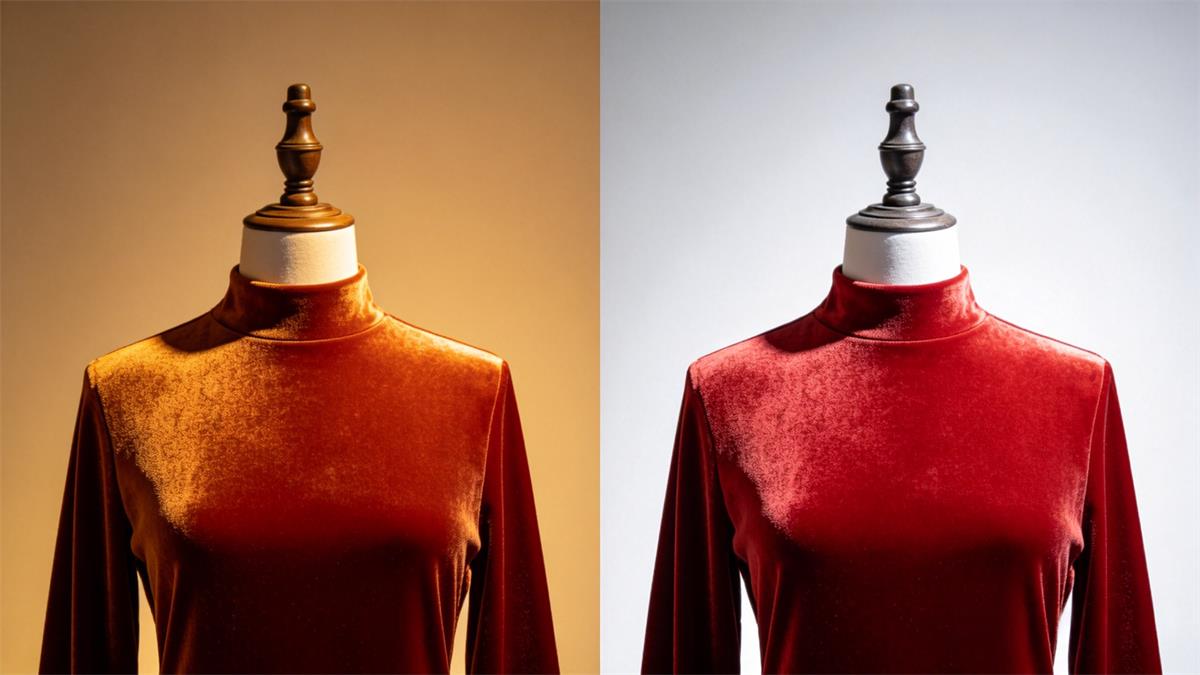
Colour temperature decides whether red velvet reads as expensive or as dull maroon. Warm light in the 2700 to 3000K range flatters holiday merchandise, while anything above 4000K drains it.
| Layer | Colour temperature | Placement | Mistake to avoid |
|---|---|---|---|
| Key light | 2700 to 3000K | 30 to 45 degrees from vertical, front-top | Straight overhead, which hollows out faces |
| Fill light | 3500 to 4000K, low output | Opposite side, below the key | Skipping fill, so one side of the form goes black |
| Sparkle accent | Warm micro LED | Behind the focal point, never in front of glass | Lights strung across the glass, which kills sightlines |
| Backdrop wash | 2700K, dimmable | Grazing the back wall | Lighting the floor, which adds nothing |
Ask for a CRI of 90 or above on any new fixture. Below that, reds and greens shift, and shoppers read the garment as cheaper than it is. This is also the least expensive upgrade on the list, because a dimmable warm fixture will serve every season after this one.
What does a Christmas window cost, and where does the money go?
Budget follows allocation more than ambition. The table below gives three planning bands as a share of a small window budget, not as quotes.
| Band | Forms and props | Lighting | Backdrop and fabric | Install labour | What you get |
|---|---|---|---|---|---|
| Lean, reuse-heavy | 15% | 35% | 30% | 20% | Existing forms, new fabric, one warm key light |
| Mid | 35% | 30% | 25% | 10% | One new form, layered lighting, built backdrop |
| Statement | 50% | 25% | 20% | 5% | New grouping, full lighting rig, custom backdrop |
Two patterns show up in the lean band. Shops that already own their forms spend the money on light and fabric, and those two carry most of the visible improvement. Shops that rebuild from scratch every December spend the same money on props they will store for eleven months. Carrying one platform structure across Halloween, Christmas and Valentine's Day costs less and wastes less, which is the practical version of sustainability rather than a marketing claim.
How do you build it without losing a selling weekend?
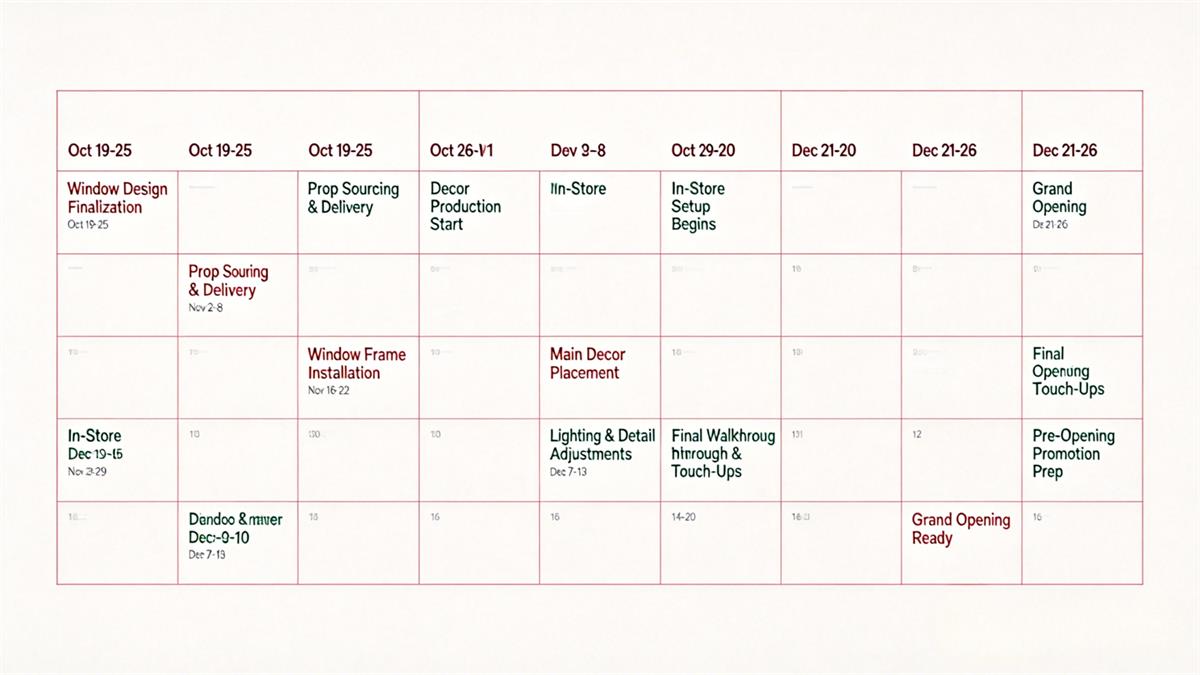
Install on the slowest day you have, and never on the Thursday before a peak.
| Week of | Task | Why it sits there |
|---|---|---|
| October 19 | Lock the concept, order props | Lead times stretch in November |
| October 26 | Sketch the elevation to scale, set focal height | Catches depth problems before anything is built |
| November 2 | Repair and clean forms, steam garments | Form repairs need parts, and parts take time |
| November 9 | Build the backdrop off-site if you can | Keeps the sales floor clear |
| November 16 | Install after close, Monday or Tuesday | Slowest trading days of the week |
| November 20 | Go live, photograph it | Full week of trading before Black Friday |
| November 30 | Refresh layer one | Two to three week refresh cadence |
| December 14 | Refresh layer two, add gifting props | Catches Super Saturday |
| December 26 | Teardown within three days | Avoids the dead-window week |
Photograph the window after install, from the sidewalk, at the height of a passerby's eye. That photo is what you will judge it by in January, and it is the asset that goes on Pinterest and LinkedIn.
How do you know whether the window worked?
One number settles it. Capture rate is store entries divided by total passerby traffic, multiplied by 100, and retail benchmarks put a healthy rate between 5% and 10% depending on sector (FootfallCam, 2026).
| Metric | How to read it | What to change next time |
|---|---|---|
| People who stop, then walk on | Attraction is fine, promise is weak | Sharpen the message, shorten the headline |
| Stop, then enter, then leave fast | Window overpromised the interior | Match the first bay inside to the window |
| Entry without buying the featured item | Focal point is wrong | Move the hero to 48 to 60 in and re-aim the key light |
| Capture rate below 5% | The window is invisible at speed | Add contrast, add negative space, remove clutter |
If you have no people counter, run an A/B test instead: change one variable, hold it a minimum of 14 days to cover two full weekend cycles, and compare entry counts against the same two weeks of the previous year (FootfallCam, 2026).
What are the mistakes that quietly kill a Christmas window?
Most failures are ordinary, and all of them are fixable before install week.
Lights in front of the glass. They reflect the street back at the shopper and hide the merchandise.
Cool white light on warm merchandise. Reds and greens go grey above 4000K.
Three forms in a row at the same height. It reads as inventory, not as a scene.
Signage at ankle height or above the sightline. The message needs to sit between 48 and 60 inches.
No refresh layer. By week four the regulars have stopped seeing it.
Leaving the display up into January. Strip it within three days of Christmas.
Buying props before measuring the window. Depth decides the layout, not the other way around.
Ready to plan your Christmas window?
Start with the forms you already have, then spend on light and fabric. Browse female mannequins, male mannequins, kids mannequins and dress forms to fill the gaps in a grouping, and contact the team if you want a second opinion on a layout before install week.
About the Author
Brook Chen is a Visual Merchandising Specialist at awmannequins.com. With over 8 years of experience designing window and in-store displays for retail brands across the US, Canada, and Australia, she helps boutiques and stores translate seasonal concepts into store-ready merchandising.
Frequently Asked Questions
When should Christmas window displays go up in 2026?
Lock the concept in the week of October 19 and install in the week of November 16, so the window is live for a full selling week before Black Friday on November 27. NRF counts the holiday season as November 1 through December 31, so a window that goes up after Halloween has already missed two weeks of seasonal trading.
How much does a Christmas window display cost?
It depends far more on what you already own than on the concept. Shops that reuse their existing forms and platform spend their budget on lighting and fabric, which is where most of the visible improvement sits. Display mannequins range from about $60 to $600 each, so buying a full new grouping is the single decision that turns a lean build into a statement build.
What colors work best for Christmas window displays?
Traditional red and green still read fastest at walking speed, but the palette matters less than the light. Warm light between 2700K and 3000K keeps reds rich, while anything above 4000K turns them muddy. A neutral or metallic backdrop with one strong accent colour is easier to refresh than a fully themed scene.
Do mannequins need to be dressed in holiday clothing?
No, and often they should not be. A form in a wearable coat with a wrapped box in hand sells more than a form in a novelty outfit, because the shopper can picture the purchase. Keep the garment sellable, keep the styling simple, and let the props carry the season.
How long should a Christmas window stay up?
Take it down within three days of Christmas. Plan one refresh around November 30 and a second around December 14 so the window keeps changing while it is up, which matters because December is the longest-running display of the year and the regulars stop registering it after about three weeks.