

Holiday Retail Display Ideas: A Visual Merchandising Calendar for the 2026 Season
Holiday retail display ideas are seasonal window and in-store concepts built around one specific shopping moment, and the most reliable way to make them pay off is to plan them on a calendar rather than in the week before the date. A visual merchandising calendar maps every retail node of the year, from back-to-school through Christmas, to a fixed lead time, a clear display job, and a teardown date. Most seasonal installs need six to eight weeks of lead time to land well, which is why Halloween work starts in early September and Christmas concepts get locked in October. This guide lays out the full 2026 calendar, the lead time each node really needs, the mannequins and forms that carry each holiday, budget tiers for small shops, and a simple scorecard for judging whether the display earned its keep.
What is a visual merchandising calendar, and why does it beat last-minute planning?
A visual merchandising calendar is a dated plan that assigns every selling moment of the year a concept, a lead time, an install window, a refresh date, and a teardown date. It turns seasonal work from a scramble into a schedule. Without one, most stores decide on a theme somewhere between one and two weeks before the date, which leaves no room for prop sourcing, no time to test a layout, and no budget left after the merchandise buy.
The calendar matters because timing is not cosmetic. Halloween 2026 falls on a Saturday, which changes how a shop should plan: foot traffic builds across the whole final week rather than peaking on a single weeknight, and a display that goes in on the Monday before has five selling days instead of one. Christmas 2026 falls on a Friday, which pulls the last heavy shopping weekend forward. These are planning facts, not trivia, and they belong on the calendar before any props get ordered.
There is also a measurement argument. Seasonal windows get judged on a handful of days, so a weak install cannot be corrected in week three. Planning backward from the date is the only way to protect the days that actually pay.
How much lead time does each holiday display really need?
Lead time is the single number that decides whether a seasonal display looks designed or improvised. The ranges below come from what has to physically happen: concept approval, prop sourcing, production or printing, staff scheduling, install, and a live week to fix what looks wrong from the sidewalk.
| Retail node | 2026 date | Start planning | Install by | Realistic lead time |
|---|---|---|---|---|
| Back to school | Late July to late August | Early June | Mid-July | 6 to 8 weeks |
| Labor Day | September 7 | Early August | August 29 | 3 to 4 weeks |
| Halloween | October 31 (Saturday) | Early September | October 3 | 6 to 8 weeks |
| Black Friday | November 27 | Mid-October | November 13 | 4 to 6 weeks |
| Cyber Monday | November 30 | Mid-October | November 20 | 4 to 6 weeks |
| Christmas | December 25 (Friday) | Late October | November 20 | 6 to 8 weeks |
| Valentine's Day | February 14, 2027 | Early January | January 30 | 4 to 6 weeks |
| Easter | Late March 2027 | Early February | Mid-March | 4 to 6 weeks |
Two nodes in that table deserve more time than shops usually give them. Halloween needs the full six to eight weeks because costume and prop inventory sells out early, and because the display has to survive three to four weeks of public life before the date arrives. Christmas needs the same window for a different reason: it is the longest-running display of the year, so the concept has to stay interesting for five to six weeks rather than five days.
Halloween also has an early-shopper problem worth planning around. NRF reported that as of early August 2026, one-quarter of consumers had already purchased at least one Halloween item, and 42% said fall weather pushed them to start shopping. A store that installs on October 24 has already missed a measurable slice of the season.
What does the full 2026 retail display calendar look like?

The table below is the working calendar. Each row gives the job the display has to do, not just the theme, because the job decides what goes in the window.
| Month | Node | Display job | Hero format | Teardown |
|---|---|---|---|---|
| July to August | Back to school | Solve a problem, not a mood: uniforms, layering, backpacks | Kids or teen forms, grouped in twos | Early September |
| September | Labor Day, early fall | Shift color temperature from bright to warm | Female form in transitional layers | Late September |
| October | Halloween | Commit to one readable silhouette at distance | Full-body form plus a dress form for costume detail | November 1 |
| November | Black Friday to Cyber Monday | Communicate value fast, keep the path clear | Torso or dress form, minimal props | November 30 |
| December | Christmas | Build gifting vignettes at eye level | Mixed family grouping, dresses and outerwear | Late December or early January |
| January | New year, clearance | Strip back, let price lead | Single abstract form | Mid-January |
| February | Valentine's Day | Small, tight, high-margin | Female or male form with accessories | February 15 |
| March to April | Easter, spring | Reintroduce light color and daylight balance | Kids forms plus a female form | Mid-April |
| May | Mother's Day | Gift-led, soft palette | Female form, seated or relaxed pose | Mid-May |
| June to August | Summer | Slow cadence, maintenance mode | Minimal, rotate every four weeks | Late August |
Notice that November is the only month where two nodes overlap with opposite display jobs. Black Friday wants clarity and speed; Christmas wants warmth and abundance. Trying to serve both in one window produces neither, which is why the next section treats the handoff as its own task.
How do you plan Halloween window displays with eight weeks to go?

Eight weeks out from Halloween, the work is mostly decisions, not labor. Week one is concept and budget. Week two is props and any custom elements, because printed or built pieces are the slowest part of the chain. Weeks three and four are for testing the composition off-site or after hours, which costs nothing and prevents the most common failure: a window that looks good from inside the store and unreadable from the sidewalk.
The display itself should commit to one silhouette. Halloween decorating spend reached about $4.2 billion in 2025, so the visual field is crowded, and crowded fields reward a single legible shape over a busy scene. A dark background with one lit form reads from across the street. Three lit forms against a patterned backdrop reads as noise.
Plan the teardown in the same meeting as the install. Halloween landing on a Saturday in 2026 means the display should come down either the Sunday after or the following Monday, and the crew that installs it should be the crew that removes it, because they know how it came apart.
For mannequin selection and pose matching on this node, our back to school window display ideas guide covers the same sequence with a shorter runway, and the fall window display ideas article covers the color transition that leads into it.
How do you hand off from Halloween to Black Friday to Christmas without losing a weekend?
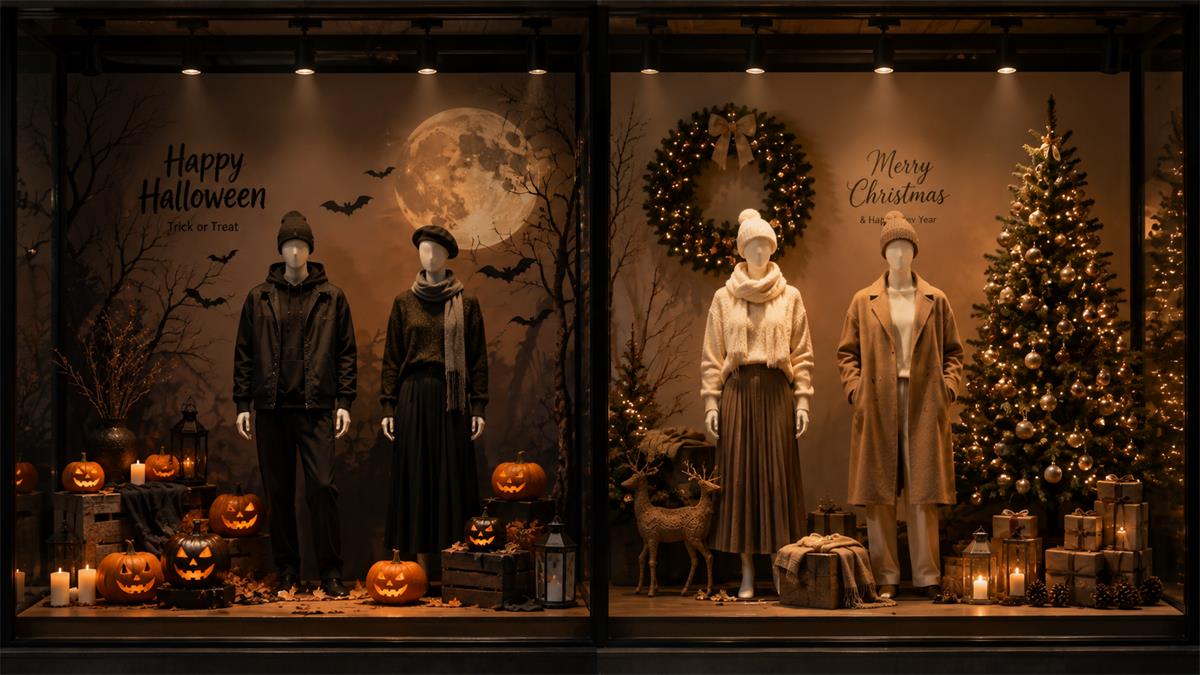
The handoff is where most seasonal calendars break. A full teardown between each node costs two to three selling days of labor and often leaves the window empty on a high-traffic weekend. A better approach is layered changeouts: keep the structure, swap the layer that carries the message.
Halloween to Black Friday is a hard reset on mood but a soft reset on structure. Strip the themed props, keep risers and platforms, and replace the backdrop. Black Friday windows should be legible in under two seconds, with fewer elements and larger type. Merchandise density goes up, prop density goes down.
Black Friday to Christmas is the opposite direction. Keep the platforms, warm the lighting temperature, and add depth rather than more product. By this point in the year the store has already spent its prop budget, so the Christmas layer should lean on things that last: fabric, greenery, warm light, and reusable backdrops.
Our window and in-store display ideas guide goes deeper on layering and composition for stores that want the full method.
Which mannequins and display forms carry each holiday?

Different nodes need different formats, and using the same form all year is one of the quiet reasons seasonal displays feel flat. A form that works for Halloween drama does not automatically work for Christmas gifting.
| Node | Best format | Why it works | Styling note |
|---|---|---|---|
| Back to school | Kids and teen forms | Scale matches the shopper and the buyer | Group in twos, keep the path clear |
| Early fall | Female full-body, relaxed pose | Carries layered looks | Three to five tones maximum |
| Halloween | Abstract or egg-head full body | Silhouette reads at distance | One hero, dark ground, single accent color |
| Black Friday | Torso or dress form | Shows value without a full story | Price and product lead, props minimal |
| Christmas | Mixed grouping (female, male, kids) | Gifting is bought across recipients | Build vignettes at 48 to 60 inches |
| Valentine's Day | Female or male form, seated option | Small scale suits a small holiday | Accessories do the work, not props |
| Spring and summer | Abstract forms, matte finish | Keeps the floor feeling light | Rotate every four weeks |
If you are rebuilding the roster rather than styling one holiday, start with the types of mannequins for retail breakdown, then use the mannequin size chart to match proportions to your actual customer base. For a planning-level view of where each form sits on the floor, the retail display mannequins guide covers placement as well as selection, and the how to style a mannequin walkthrough covers the hands-on work.
How do you build a holiday display on a boutique budget?
Budget is the constraint that kills most seasonal plans, and it usually fails in the same way: the merchandise buy absorbs everything, and the display gets whatever is left in the final week. Fixing that means allocating display spend as its own line before the buy, at one of the tiers below.
| Tier | Typical spend per node | What you get | Best for |
|---|---|---|---|
| Lean | Under $300 | Fabric, printed signage, reusable risers, one accent light | Single-window boutiques |
| Standard | $300 to $1,200 | Backdrop, themed props, two to three accent lights | Most independent stores |
| Statement | $1,200 and up | Custom build or new forms, programmed lighting, multi-window story | Flagship and high-street locations |
The single highest-return line in every tier is lighting. A lean budget with one well-aimed accent light beats a standard budget with flat overhead wash, because light is what creates the focal point that makes the window readable. The second-highest return is a backdrop, because it is the fastest way to change a season without touching the merchandise.
Across tiers, buy props that survive more than one year. Around 70% of consumers say they prefer to buy from environmentally responsible brands, and 84% say sustainability is at least moderately important, so a display built from reusable materials supports the brand story as well as the budget. Reuse also compounds: the third year of a modular system costs close to nothing.
How should lighting change between Halloween and Christmas?
Lighting is the fastest lever a store has, and it is the one most often left on a single setting all year. Two numbers do most of the work: color temperature and beam angle.
| Node | Color temperature | Beam approach | Common mistake |
|---|---|---|---|
| Back to school | 4000K neutral | Even wash, high output | Warm light making uniforms look dull |
| Early fall | 3000 to 3500K warm | Key plus fill | Switching too early and clashing with summer stock |
| Halloween | 2700 to 3000K warm, low ambient | Tight accent on one form, deep shadow | Lighting the whole scene evenly and killing the drama |
| Black Friday | 4000K neutral, bright | Wide even coverage | Mood lighting that makes price tags hard to read |
| Christmas | 2700 to 3000K warm, layered | Key, fill, and sparkle accents | Cool white LEDs on warm holiday merchandise |
| Spring and summer | 4000K neutral, daylight-balanced | Broad, bright | Keeping December warmth into March |
The pattern is simple: warm light for emotional buying, neutral light for decision buying. Halloween and Christmas sell feeling, so they get warm and directional. Black Friday sells decisions, so it gets bright and even. Getting this wrong is expensive, because a well-built scene under the wrong temperature looks flat and unconsidered.
How do you keep one holiday display from clashing with the next?
Clashing usually happens in the gaps, not the peaks. The week after Halloween and the week after Christmas are the two moments when stores leave transitional displays up too long, and a half-stripped window reads worse than an empty one.
The fix is a hard rule on the calendar: every node gets a teardown date set at install time, and that date is not negotiable when the calendar slips. Teardown should also include a reset to a neutral baseline, meaning clean platforms, neutral backdrop, and the store's standard lighting setting. From a neutral baseline, the next concept takes hours instead of days.
Storage is the other half. Props that get thrown in a back room come out broken, and broken props are why stores re-buy every year. Labeled bins by node, a photo of the installed display taped to the bin, and a one-page packing list turn teardown into a 30-minute job instead of a half-day.
How do you measure whether a holiday display paid for itself?
Seasonal displays get approved on feeling and renewed on numbers, so the stores that keep getting budget are the ones that can show what a window produced. Four metrics are enough, and none of them need expensive hardware.
| Metric | How to measure it | Benchmark | What a miss tells you |
|---|---|---|---|
| Dwell time | Stopwatch sampling at set hours | 45 seconds is strong, 15 seconds is weak | The concept is unclear at distance |
| Foot traffic | Door counter or manual tally, install week versus prior week | Optimized windows average about 27% more | The display is not stopping people |
| Conversion | Transactions divided by entries | 19% for brand-aligned windows | The window promises what the floor does not deliver |
| Average order value | Sales divided by transactions | Negative space correlates with about 19% higher AOV | The scene is crowded and devalues the product |
Dwell time is the easiest to start with and the most diagnostic. If people are not stopping, the problem is the concept or the lighting. If they are stopping but not entering, the problem is the entrance or the path. If they enter but do not buy, the problem is on the floor, not in the window.
Context matters for how much any of this is worth. November and December retail sales grew 4.1% in 2025 and passed $1 trillion for the first time, so the seasonal window is where the year's volume concentrates. A window that moves foot traffic 20% during that period is doing real work.
What visual merchandising trends are shaping the 2026 holiday season?

Three shifts are worth planning around this year, and all three change what a calendar has to schedule.
Earlier seasonal starts. Shoppers are buying holiday product sooner. NRF found that one-quarter of consumers had already bought a Halloween item by early August 2026, which pushes install dates earlier and lengthens the selling window a display has to survive. Calendars that assume a two-week display life are now out of date.
Modular over disposable. Reusable and reconfigurable display systems have moved from nice-to-have to expected. This is partly a cost decision and partly a brand decision, since shoppers read a well-built, long-lived fixture as a signal about how a brand operates. It also reduces the annual prop buy, which is the budget line that most often gets cut.
Fewer, better hero moments. Overcrowded windows underperform. Generous negative space correlates with about 19% higher average order value, and top-performing windows hold attention roughly three times longer than weak ones. The trend is toward one hero, executed well, rather than a full inventory in the glass.
For stores that want the sustainable angle to run as a real brand position rather than a seasonal costume, our piece on why sustainability in retail displays is about more than materials lays out the lifecycle case.
How do you store and reuse holiday props so next year costs less?
Reuse is a system, not a habit. The stores that genuinely cut their seasonal budget in year three do four things consistently.
Photograph every install. A single reference shot per node, taken straight on, removes the guesswork next year.
Pack by node, not by material. One bin per holiday beats sorting by type, because install day is organized by holiday.
Log what broke. A short note on what failed tells you what to replace and what never to buy again.
Keep a neutral baseline kit. Platforms, risers, and one spare backdrop in a neutral tone let you reset between nodes in under an hour.
The payoff is compounding. Year one is the expensive year. Year two costs the price of consumables and replacement bulbs. Year three is close to free, which frees budget for the thing that actually moves the needle: better lighting and better forms.
Frequently Asked Questions
How far in advance should you plan holiday retail display ideas?
Plan six to eight weeks before the retail node for Halloween and Christmas, and four to six weeks for Black Friday, Valentine's Day, and Easter. That window covers concept approval, prop sourcing, production, install, and a live week to fix what looks wrong from the sidewalk.
When should a Halloween window display go up in 2026?
Install by early October, roughly four weeks before October 31. NRF reported that one-quarter of consumers had already purchased a Halloween item by early August 2026, so a display that appears in the final week misses a real share of the season.
How often should you change a retail window display?
Refresh at least every four weeks. Regular passersby stop registering a static window within a few weeks, and dwell time drops as a result. Seasonal nodes may run shorter or longer, but the four-week rule should be the default between them.
How much should a small boutique budget for holiday displays?
Budget $300 to $1,200 per retail node for a standard independent store, with lighting taking priority. A lean budget under $300 still works if it goes to one well-aimed accent light and a reusable backdrop rather than to disposable themed props.
Do holiday displays actually increase sales?
The measurable effects are on attention and traffic rather than on price. Optimized windows average about 27% more foot traffic, top-performing windows hold attention around 45 seconds versus 15 seconds for weak ones, and 64% of shoppers say a unique window is a key factor in choosing which store to visit.
About the Author
Brook Chen is a Visual Merchandising Specialist at awmannequins.com. With over 8 years of experience designing window and in-store displays for retail brands across the US, Canada, and Australia, she helps boutiques and stores translate seasonal concepts into store-ready merchandising.