Halloween Retail Display Ideas That Reach Shoppers Before October
Halloween retail display ideas only pay off if the window is up while people are still spending. Nearly half of Halloween shoppers started buying in September or earlier, and one quarter had already bought something by early August 2026, so a window installed on October 27 is talking to a crowd that has finished its seasonal budget. This guide covers the concept choices, mannequin styling, lighting, and week-by-week timing that make a Halloween window sell, and it links out to the full visual merchandising calendar for everything that comes after.
Why should Halloween displays go up before October?
Because the buying happens before the holiday. The National Retail Federation reported that 49% of consumers began shopping for Halloween in September or earlier in 2025, up from 47% the year before and from just 34% a decade earlier (NRF, September 2025).
The pattern has moved earlier again this year. In a survey published on September 1, 2026, NRF found that one quarter of consumers had already purchased a Halloween item by early August, with adult costumes and candy the most-purchased categories so far, and the share of early shoppers buying children's and pet costumes roughly doubled year over year (NRF, September 2026).
Weather is the trigger. The same NRF analysis found that 42% of celebrators say fall weather is what pushes them to start Halloween shopping, and that figure runs higher in the Midwest and Northeast where autumn arrives first. For a store in those regions, a display that waits for a calendar date rather than the first cold snap is late.
The practical read is simple. Treat the first cool week of September as your install deadline, not the last week of October, and plan for the display to live five to six weeks. If you need a bridge between late summer and the spooky season, the fall window display ideas route of harvest tones and layered knits sets up an easy October pivot.
What do the Halloween spending numbers say about what to display?
Decorations reach more shoppers than costumes do, and that changes what belongs in the window.
| Category | Share of shoppers planning to buy | 2025 US spend |
|---|---|---|
| Decorations | 78% | $4.2 billion |
| Costumes | 71% | $4.3 billion |
| Candy | Most popular single purchase | $3.9 billion |
| Greeting cards | 38% | $0.7 billion |
Total 2025 Halloween spending reached a record $13.1 billion, with per-person spending at a record $114.45 and 73% of consumers planning to celebrate (NRF, 2025).
Read that table as a merchandising instruction rather than trivia. Decorations have the widest purchase intent at 78%, so a scene built from props, backdrop, and light speaks to more people than a rack of costumes does. Apparel stores are the exception, because the costume numbers are strong enough to justify a styled outfit wall, and the most popular adult costumes in 2025 were witch (5.6 million), vampire (2.7 million), pirate (1.6 million), cat (1.6 million), and Batman (1.6 million).
Impulse categories deserve floor space near the window. Candy and cards are low-ticket, high-frequency, and easy to place at the counter, which is how a seasonal window converts into a larger basket rather than just a photograph.
How do you choose a Halloween concept that fits your store?

Pick one focal idea and let everything else support it. A passerby gives a window roughly three seconds, so a concept that needs explaining has already lost.
| Concept | Best for | Mannequins | Build effort | Merchandising payoff |
|---|---|---|---|---|
| Moody gothic (black backdrop, bare branches, one figure) | Fashion, apparel, footwear | 1 to 2 | Low | High contrast makes product pop |
| Harvest neutral (wheat, amber, plaid, timber) | Home, gift, family, grocery | 2 to 3 | Low | Longest usable window, easy Christmas pivot |
| Playful pumpkin (oversized props, small figures) | Children's, family, party | 2 to 3 kids | Medium | Strong social sharing, high dwell |
| Phantom ball (masks, frames, floating dresses) | Occasion wear, bridal, accessories | 2 to 4 | High | Editorial look, strong Pinterest reach |
| Window as a film set (built scene with a story) | Flagship, high footfall streets | 1 to 2 | High | Press and local coverage potential |

Budget is rarely the constraint. Retail design consultants quoted in trade press routinely build effective seasonal windows for under $100 by reusing risers, repainting a backdrop, and changing only the props and the dressed product.
How should mannequins be styled for Halloween?

Dress the figure in sellable merchandise and add season with props, not with costume. A mannequin wearing a full witch outfit sells one costume. A mannequin wearing your actual outerwear with a single dark floral crown, an amber scarf, or a black lace overlay sells the coat and reads seasonal at the same time.
Pose does most of the work. A relaxed, weight-shifted pose reads as wearable and keeps the garment the hero. A dramatic, extended pose reads theatrical and suits costume, occasion, and window-as-set concepts. Matching pose to merchandise matters more than matching pose to the holiday.
Finish changes how the figure behaves under Halloween lighting. A matte finish absorbs light and holds a mood under a single spotlight, which is why it suits gothic and harvest schemes. A gloss finish reflects every light source in the room and tends to fight a dark backdrop, so reserve it for bright, playful schemes with even light.
Head choice is a cheap lever. A headless or abstract form reads eerie at no cost and keeps attention on the garment, but it removes the ability to merchandise hats, jewelry, and eyewear. Keep a mix: one abstract or headless figure in the window for mood, and full figures on the floor for accessories.
Skin tone and body type should stay consistent with your brand year round. Seasonal displays are not the place to introduce a body type that does not appear in your sizing range, because shoppers read it as a signal about who the store is for.
For the deeper selection logic on size, pose, and finish, the mannequin selection guide covers the trade-offs in detail, and the how to style a mannequin walkthrough covers dressing technique step by step.
Which lighting and layout rules make a Halloween window work after dark?
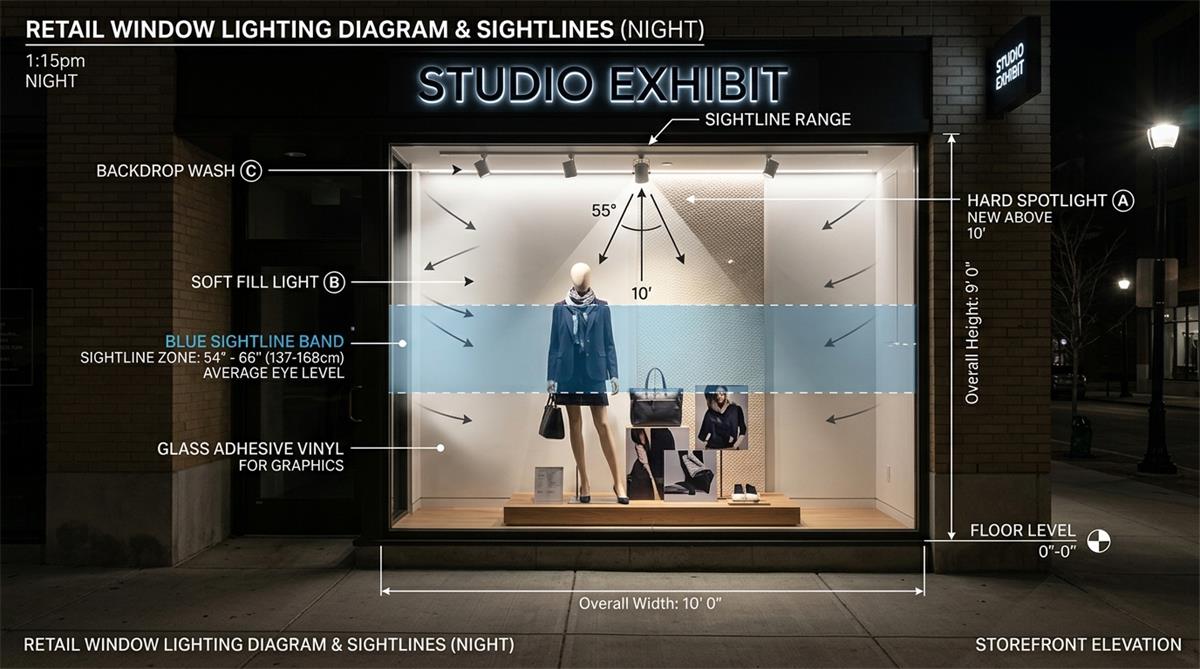
Halloween is the one season when a large share of display viewing happens in the dark, so the lighting plan matters more than the prop list.
Start with sightlines. Products placed at eye level, roughly 54 to 66 inches from the floor, are about 82% more likely to be picked up and bought, and well-designed window displays have been credited with lifting retail foot traffic by around 23% (Contra Vision, compiled stats). Put the hero product in that band and keep everything else above or below it.
Then choose a color temperature that matches your concept and protects skin tones:
Harvest and family schemes: 2700K to 3000K warm amber, broad and even, low contrast
Gothic and phantom schemes: narrow spot from above at 3000K, with a cool accent from the side, and at least one soft fill so faces and fabric texture stay readable
Playful schemes: even white light around 3500K so orange, purple, and green props stay saturated instead of muddy
Add a backlight or a silhouette layer if the window is deep. A single figure lit from behind against a lighter backdrop reads at 40 feet, which is the distance most pedestrians decide whether to look.
Keep the floor and the glass clean and uncluttered. Research compiled by retail media found that a third of shoppers abandon stores because displays are disorganised, and that minimalist presentations can raise perceived product value by roughly 28% (Autumn Fair, June 2026). One hero, generous empty space, and clean sightlines beat a packed window every time.
How do you turn a Halloween window into Pinterest and Instagram content?
Shoot the window as content on install day, not as an afterthought. NRF's 2025 survey found that online searches were the leading source of Halloween inspiration at 37%, ahead of in-store browsing at 27%, which means the seasonal audience is looking on screens first and sidewalks second.
A workable shot list takes about 15 minutes:
One horizontal frame at 1200 x 675 for the blog, email, and Google Discover
One vertical frame at 1000 x 1500 for Pinterest, cropped tight on the hero figure
One five second walkthrough for Reels, TikTok, and YouTube Shorts, shot at dusk while the window lights are doing the work
One detail close-up of the merchandise, which is the frame that actually drives add to cart
Shoot at dusk, not in daylight. Window lighting reads as a flat grey in daytime photos and as drama once the street has gone dark.
Post the same window three or four times across the five week run with different crops and captions. Most stores shoot once and post once, which wastes the single most shareable asset of the season.
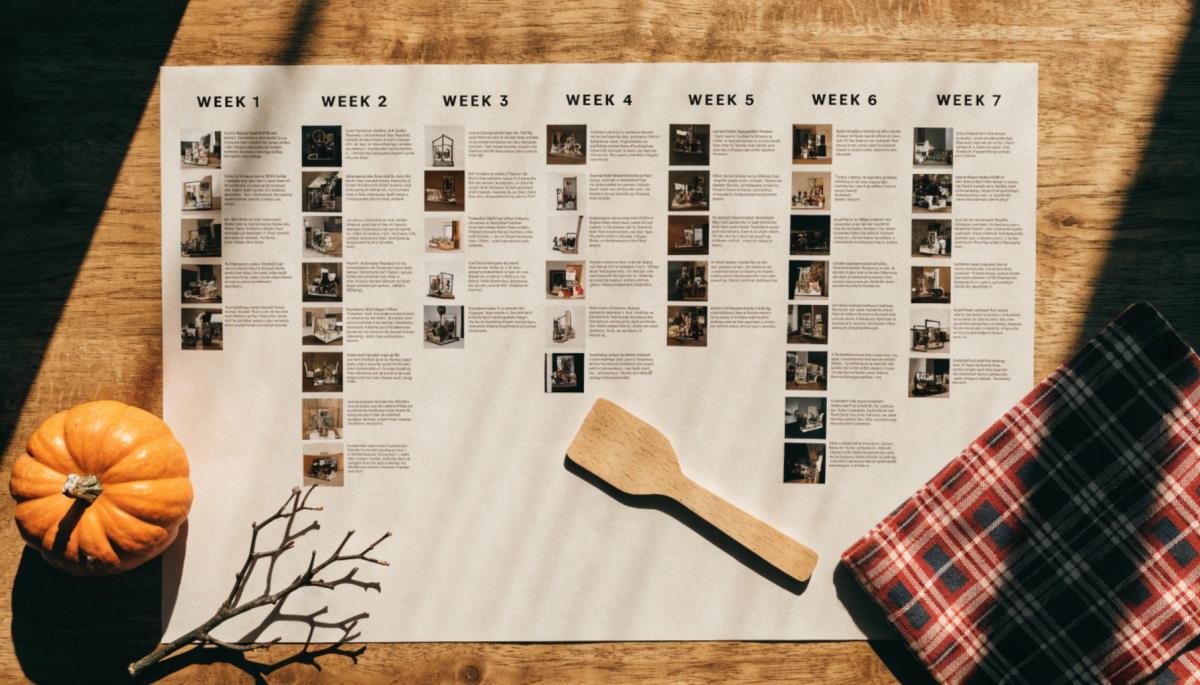
What does a seven week Halloween display timeline look like?
This is the schedule that lines up with the early shopping data. Adjust the week numbers to your own install capacity, but keep the order.
| Timeline | Focus | Action |
|---|---|---|
| 7 weeks out (week of Sep 8) | Plan | Lock the concept, order props, service and clean mannequin bases and joints |
| 6 weeks out (week of Sep 15) | Build | Assemble props off site, test lighting angles, pre-dress the figures |
| 5 weeks out (week of Sep 22) | Install | Install the window, run the shot list, post the first Pin |
| 4 weeks out (week of Sep 29) | Extend | Add in-store tie-ins near the entrance, refresh the hero rail |
| 3 weeks out (week of Oct 6) | Rotate | Swap the hero product, second shoot, refresh props that have faded |
| 2 weeks out (week of Oct 13) | Push | Add costume, party, and candy merchandising, raise signage |
| 1 week out (week of Oct 20) | Peak | Full display, extended evening lighting, daily restock check |
| Nov 1 onward | Pivot | Strip novelty, keep infrastructure, move to the holiday scheme |
Two rules keep this from becoming a second job. Build props off site so the store is never closed or messy, and pre-dress figures before install day so the window goes up in one session.
How do you move from Halloween into Black Friday and Christmas?
Keep the hard infrastructure and change the soft goods. Risers, backdrop frames, lighting positions, and base plates are the expensive, time-consuming parts, and none of them need to be Halloween specific. Strip the novelty props, repaint or re-cover the backdrop, and swap amber for deep green or gold.
This is where the season earns its keep. A store that builds a reusable display skeleton in September and re-skins it three times spends a fraction of what three separate builds would cost. The window and store display ideas guide covers the reusable frame approach, and the visual merchandising calendar maps the full sequence from Halloween through Christmas and into January markdowns.
Do the teardown on a Tuesday or Wednesday. Pulling a Halloween window down on November 1 morning leaves the storefront blank during a week that still carries traffic.
Frequently Asked Questions
When should a store put up Halloween displays?
Install by the third week of September for most US markets, and earlier in the Midwest and Northeast where cold weather arrives first. NRF data shows 49% of shoppers began buying in September or earlier in 2025, and one quarter had already bought by early August 2026, so a late October install misses most of the spending.
How many mannequins should a Halloween window use?
One or two for a small window, three at most for a wide one. A single figure with a strong prop and a hard spotlight reads better than a crowded group, and it keeps the hero product in the eye-level band where purchase likelihood is highest.
What colors work best for a Halloween retail display?
Black with one accent, or amber with deep green. Black backdrops make merchandise pop and suit fashion, while harvest amber suits family, home, and gift stores and transitions into Christmas with almost no rework. Avoid the full orange plus purple plus green trio, which reads as a party aisle rather than a brand.
Can a Halloween display offend shoppers?
Yes, and the common triggers are gore, religious imagery, and anything that plays on violence or mental illness. Storefronts draw families during daylight hours, so aim for eerie and stylish rather than frightening. When in doubt, run the concept past two staff members who are not on the design team.
How do you light a Halloween window at night?
Use one hard spotlight on the hero figure from above and slightly in front, one soft fill to keep faces and fabric readable, and a backlight or backdrop wash for depth. Keep total light on the merchandise at least three times brighter than the street outside, or the glass turns into a mirror after dark.
About the Author
Brook Chen is a Visual Merchandising Specialist at awmannequins.com. With over 8 years of experience designing window and in-store displays for retail brands across the US, Canada, and Australia, she helps boutiques and stores translate seasonal concepts into store-ready merchandising.
Ready to build the window? Browse female mannequins, male mannequins, kids mannequins, or dress forms, or talk to the display team about a seasonal package.