
Window Display Lighting That Sells: Layering, Color Temperature and Timing
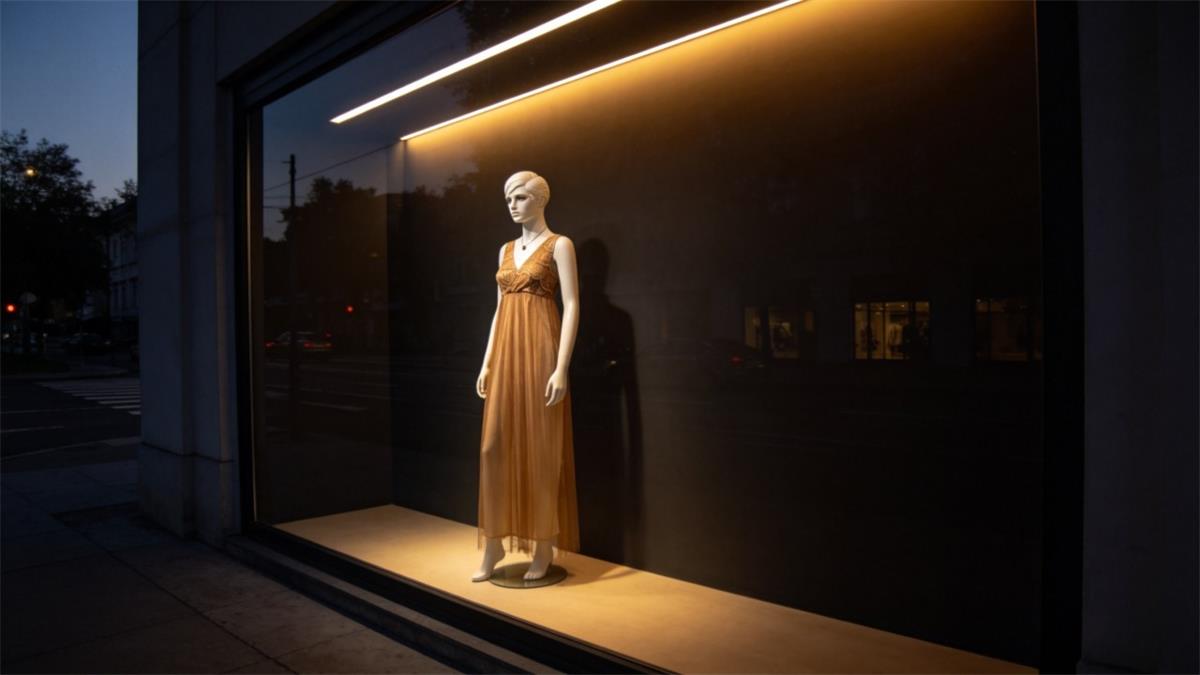
Window display lighting is the layered use of ambient, accent and fill light to make a storefront read from the pavement, at eye level, in every hour the store is open. It is not the same job as interior lighting, and it is not decoration: a passerby gives a window a few seconds, and light is what decides whether the outfit inside is legible in that time. Three numbers frame the work for the next quarter. Street-facing exterior lighting was the second strongest driver of shopping decisions out of ten store factors measured in a 2025 peer-reviewed study (path coefficient 0.517), window display itself scored 0.510, and November plus December has averaged about 19% of total US retail sales over the last five years. This guide covers the three layers, color temperature by product category, beam angles, the daylight-to-dark switch, and the weekly check that keeps a window looking the way it did on install day.
What is window display lighting responsible for?
Three jobs, and they are ranked. First, stop a person who is walking past at normal speed; that happens through contrast against the street rather than through raw brightness. Second, let the garment be read at two to four meters: fabric, color, cut and the styling decision. Third, carry the brand after dark, when most of the day's pedestrian traffic in a shopping district happens in fall and winter.
That order matters because it explains the most common failure in small-store windows. When a shop lights everything evenly, nothing wins the eye. The fixture list is fine, the lamps are fine, and the window is still flat. Lighting a window is a sequencing problem: one focal point, a supporting wash, and shadow left in the right places.
Why does window lighting matter more from October onward?
Because the window's working hours change, and window display lighting has to carry the display earlier every week. Through summer, daylight does most of the work until the last hours of trading. From October, a window that was carried by daylight at 4 pm in August is relying on fixtures by 5 pm, and shoppers are walking home in the dark.
The commercial calendar reinforces it. November and December have averaged roughly 19% of total US retail sales over the last five years, and NRF's 2025 forecast put holiday spending at $1.01 trillion to $1.02 trillion, a 3.7% to 4.2% increase over 2024 (NRF Winter Holiday FAQs, 2025). Consumers said they planned to spend $890 each, and about two in five had started browsing before November. For a small store, that means the window is doing its most valuable work in the months when it is also the darkest, and when pressure on the door is highest.
The published research points the same way. Researchers surveying 488 shoppers across southern retail districts found exterior lighting was the second most influential factor among ten store elements tested, behind only product arrangement, with window display third and mannequins fourth. Their model explained 66.4% of the variance in purchase decisions (Florea et al., Journal of Theoretical and Applied Electronic Commerce Research, 2025). Separately, a 2026 systematic review of twenty lighting studies concluded that illuminance and correlated color temperature are the two parameters that most reliably shape visual attention and emotional response in retail settings (ARCADE, Vol. 10 No. 1, 2026). Read together, that is a short instruction: brightness and its color do the work, so they should be planned rather than inherited from whoever installed the track a decade ago.
What are the three layers every window needs?
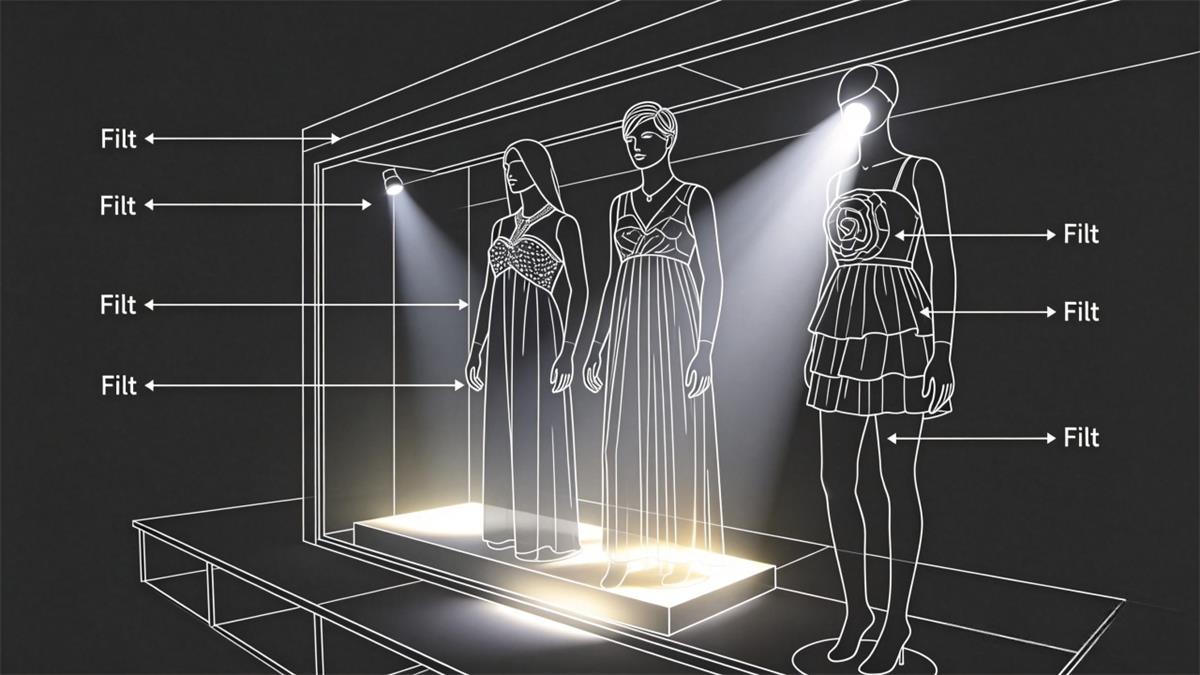
A window works when three layers are doing different jobs at different intensities. The table below is the planning order to use, because the accent layer almost always deserves the largest share of the fixture budget in a clothing window.
| Layer | What it does | Typical fixture | Beam angle | Where it aims | Share of fixture budget |
|---|---|---|---|---|---|
| Ambient / key | Establishes the base exposure so nothing sits in dead black | Recessed downlights, a wash head on the ceiling track, wall washers | 36 to 50 degrees | Across the floor plate and back wall | 30 to 40% |
| Accent | Makes one mannequin or one garment the brightest thing in the frame | Track heads, adjustable spots, picture lights, shelf strips | 15 to 36 degrees | Chest height on the focal form, from above and slightly off-axis | 45 to 60% |
| Fill | Lifts the base and plinth so shoes, hems and lower product are not lost | Low-output strip, plinth LED, small flood | 60 degrees or wider | The floor line and the underside of the grouping | 5 to 15% |
| Decorative (optional) | Carries an idea: a hanging pendant, a lamp as a prop, a light tube in the set | Pendant, neon, exposed filament | Not applicable | Anywhere it supports the story | Only if the story needs it |
Two practical notes. The fill layer is the one most often missing, and it is why so many small windows look as if the mannequin's feet have been deleted. The decorative layer is the one most often over-used, because a pendant that reads beautifully in a photograph can become the brightest object in the window and pull attention off the merchandise.
How do you choose color temperature and CRI for your merchandise?
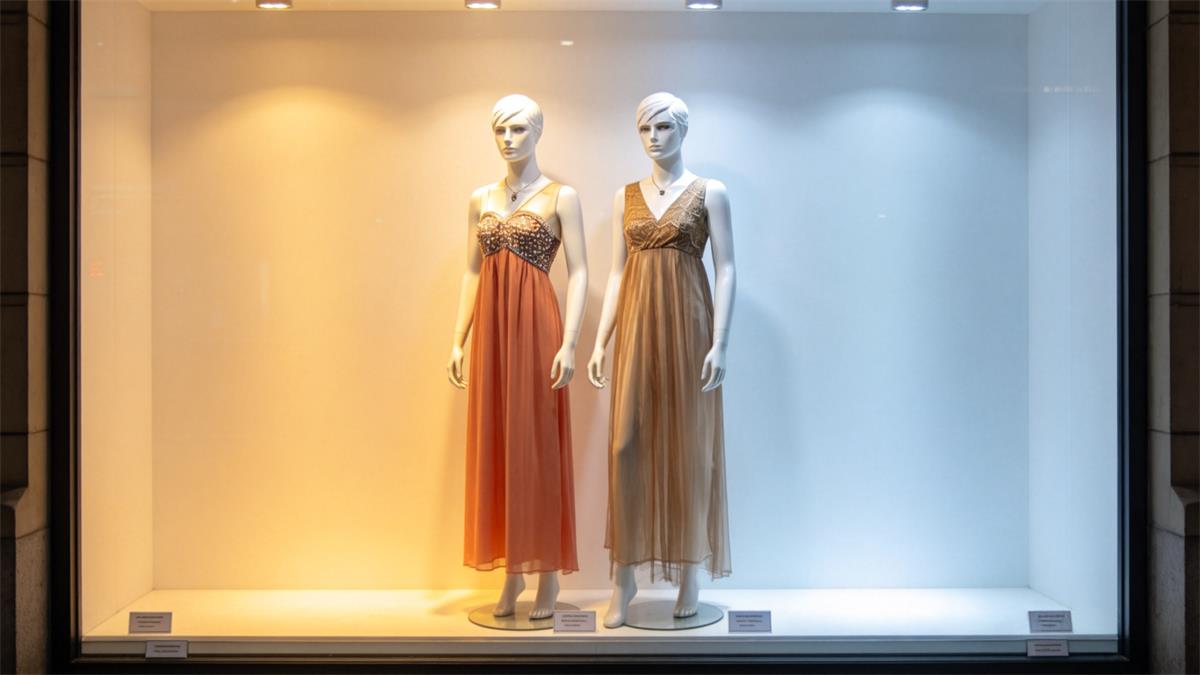
Color temperature decides what the product looks like. Cool light reads clean and modern on technical fabric and cool colors; warm light flatters skin, knitwear, wood and anything with a heritage story. A single window should use one color temperature family, because mixed lamps make two identical mannequins look like they came from different stores.
Color rendering matters more than most owners expect. Rendering index at 90 or above keeps deep reds, navy and denim from going muddy, which is the quiet cause of "it looked different in the store" complaints and returns.
| Merchandise category | Color temperature | CRI target | Notes |
|---|---|---|---|
| Knitwear, wool, heritage and outdoor brands | 2700K to 3000K | 90+ | Warm light holds texture and makes natural fibers feel premium |
| Womenswear, occasionwear, beauty | 3000K to 3500K | 90+ | Neutral band that keeps skin tones consistent across a grouping |
| Denim, menswear, sportswear | 3500K to 4000K | 90+ | Slightly cooler light separates indigo from black and defines seams |
| Jewelry, watches, accessories | 3500K to 4000K | 90+ | High output on small surfaces, so keep the beam narrow and control glare |
| Kids and lifestyle | 3000K to 3500K | 90+ | Avoid an overly warm cast if the fixtures also light the aisle |
How bright should a window be, and how do you check it?
The useful measure is not brightness in isolation, it is the ratio between the focal point and everything around it. A window reads from the street when the mannequin is roughly three to five times brighter than the surrounding surfaces; below that, the eye has nothing to resolve and moves on.
These are working targets used in retail lighting plans, not universal code requirements. Glass type, facade recess, local signage rules and the reflectivity of the sidewalk all shift the numbers, so treat the table as a starting point and confirm it with a meter.
| Zone / what to measure | Starting target | Why |
|---|---|---|
| Focal mannequin, chest height | 3x to 5x the ambient level in the window | This ratio, not the absolute figure, is what stops a passerby |
| Plinth and floor line beneath the grouping | 60% to 70% of the focal level | Prevents the figure from floating and keeps shoes readable |
| Back panel or backdrop wall | 40% to 60% of the focal level | Gives the eye a surface to land on and hides glass reflections |
| Glass surface | As little direct beam as possible | Every visible hotspot becomes a mirror image of the street behind the shopper |
| Pavement approach | Enough contrast to silhouette the doorway | Entry legibility at a walking pace, especially after dark |
You can check all of this without hiring a lighting designer. A phone lux meter held at the mannequin's chest height gives a repeatable reading, and the same reading taken at the plinth and at the back wall gives you the ratios. Log the three numbers once a season, then again after any lamp change, because the ratios are what drift when fixtures get bumped.
How do you aim a beam so it lands on the product and not the glass?
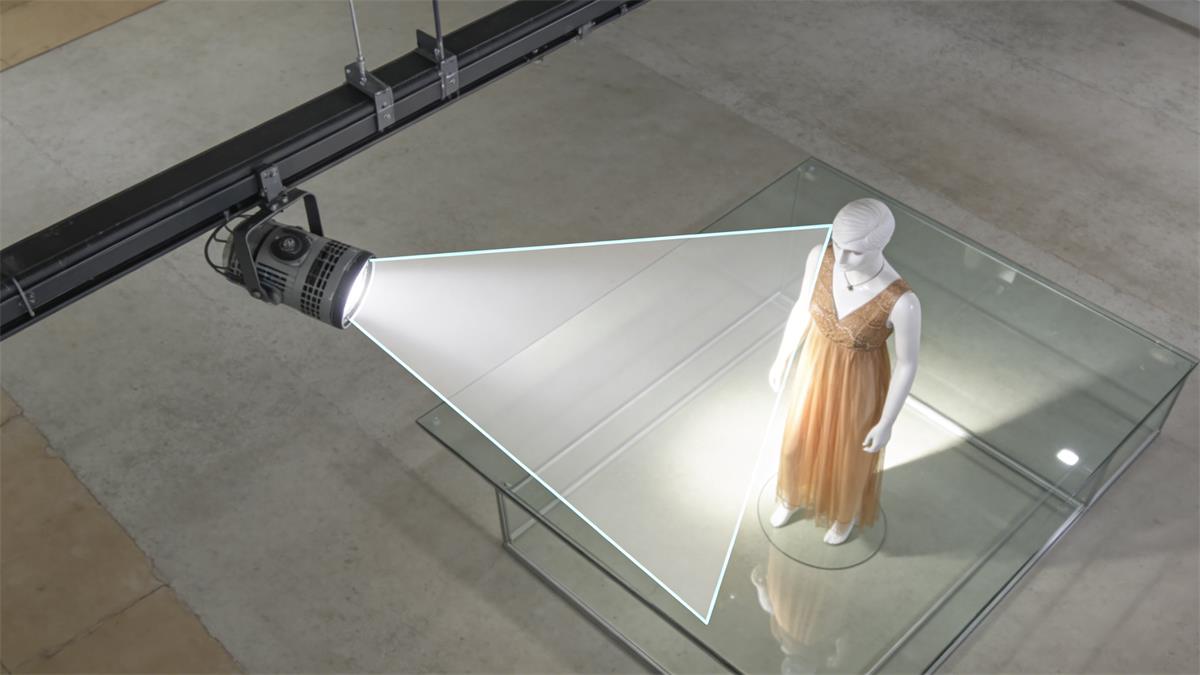
Beam angle is the part of window display lighting that most small stores leave unplanned, and it is chosen by what you are lighting rather than by what is in stock. A full-body figure at two and a half to three and a half meters usually wants a 24 to 36 degree beam so the light covers the whole silhouette without spilling into the street. A head, a bust or a handbag wants 15 to 24 degrees so the light lands on the object with a crisp falloff. A backdrop wants 36 to 50 degrees so it reads as a surface rather than a series of circles.
Three aiming rules prevent most of the problems owners describe as "the window looks wrong at night":
Mount the head behind and above the glass line, angled 30 to 45 degrees off the plane of the window. Light aimed from the front edge bounces straight out to the street and up into the shopper's eyes.
If you can see the lamp from the pavement, the passerby can see it too, and the eye will go to the lamp instead of the clothing. Snoots, honeycomb louvers and barn doors fix this for a few dollars per head.
Keep a matte, darker backdrop behind the focal mannequin. A light, glossy panel doubles every interior light source and destroys the contrast the focal read depends on.
For a brighter-first-impression trick that the research supports: under bright light, convex products read as larger to shoppers, an effect confirmed in a 2025 study in the Journal of Business Research and summarized in Fagerhult's research roundup (Fagerhult, February 2026). That is an argument for putting your strongest accent on the fullest silhouette in the window, and for keeping small accessories in a calmer pool of light rather than in the brightest spot.
What changes between daytime and evening?
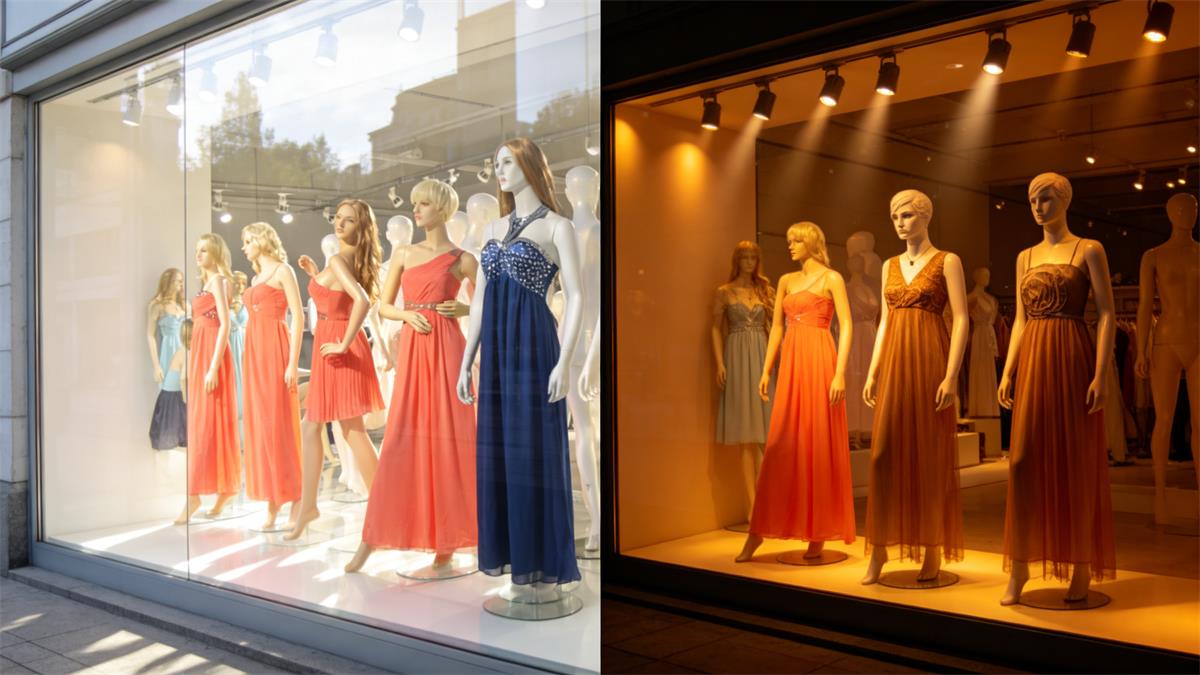
Most small stores run one lighting scene all day, and that is the reason windows look flat by late afternoon. Daylight arrives with a different color temperature and a different direction, and it falls away gradually. Around the transition hour, roughly an hour before sunset, a window that depends on ambient daylight loses its contrast before the store closes.
| Time band | What daylight is doing | Fixture scene | What to check |
|---|---|---|---|
| Midday to mid-afternoon | Strong, frontal, cool | Accent at 60% to 70%, ambient at 50% | That highlights are not blowing out on light garments |
| One hour before sunset | Falling and warming | Accent to 100%, ambient to 70% | Whether the focal figure still separates from the backdrop |
| Dusk to closing | Negligible | Full accent, ambient at 80%, fill on | Glass reflection and lamp visibility from the pavement |
| After close / late-night street | None | Dim to a low ambient scene or switch off the accent | Price cards and messaging should not read as abandoned stock |
If your track is on a single switch, the most economical upgrade is a dimmer and two scenes rather than new fixtures. If you have a photocell or an app-controlled driver, schedule the switch to the local sunset time and adjust it monthly, because the sunset in your city moves by more than an hour between September and December.
How do you light different mannequin finishes and skin tones?
Finish changes the lighting plan, and a grouping with mixed finishes needs to be lit as a set rather than as a row of individual figures.
Glossy and high-gloss forms throw specular highlights wherever the beam hits them. On a glossy white form those highlights clip to pure white and lose the garment's shape; on a glossy black form they can be the most attractive thing in the window if the beam is aimed from higher and slightly off-axis. Matte and fabric-wrapped forms absorb light, so budget roughly 20% to 30% more output on them than on a glossier equivalent to reach the same perceived brightness.
Skin tone needs consistency more than it needs warmth. Deep and mid-tone finishes reward a high rendering index and a warmer color temperature, because cool light flattens the modeling across the face and shoulders. In practice, keep every lamp in a multi-figure window within one color temperature step, and check the group after dark rather than at midday, when daylight is masking differences. If your window mixes gloss and matte finishes, aim the sharpest beam at the gloss figure and give the matte figure a wider, softer pool.
What does a window lighting plan cost, and where should the money go?
A window display lighting plan does not have to begin with new fixtures, so sequence the spending rather than replacing the ceiling. In most small stores the highest return comes from lamp quality and beam control on fixtures you already own; the lowest return comes from adding more heads at the same angle.
Step one: change the lamps to 90+ rendering index LED at a single color temperature, and add snoots or louvers to the heads closest to the glass.
Step two: split the track into two circuits so the accent layer can run independently of the ambient layer, then add a dimmer. This is what makes the evening scene possible at all.
Step three: add a dedicated narrow-beam head for each focal mannequin, and a low-output fill strip under the plinth.
The efficiency case is settled. LED products use up to 90% less energy and last up to 25 times longer than incandescent lamps, which release about 90% of their energy as heat rather than light (US Department of Energy, Consumer Guide to Energy-Efficient Lighting). That matters twice over in a display context: a window that runs twelve hours a day is one of the longest-running electrical loads in a small store, and the heat thrown by incandescent heads works against painted mannequin finishes over a season. Keeping the fixtures and replacing the lamps, rather than discarding the track, is also the lower-impact environmental answer, and it is the version most small retailers can actually execute before the holiday season.
How do you keep the window reading right all season?
Lighting drifts. Nobody re-aims a head that has been nudged, and nobody notices the third lamp in a run has shifted color until the whole window looks off. A short routine catches it.
| What drifts | What you see from the street | Fix | Frequency |
|---|---|---|---|
| Aiming | One figure half in shadow, or a hotspot on the backdrop | Re-aim to the chest-height target and re-tape the head position | Weekly during display changes |
| Dust and film on lamps and lenses | Overall dullness, weak cast on darker garments | Wipe lenses and diffusers with a dry microfiber cloth | Monthly |
| Lamp color shift | Two identical garments reading different colors | Group lamps by purchase batch and replace as a run, not one at a time | When a difference is visible |
| Dead or flickering lamp | A dark shoulder or a strobe in the corner of the window | Keep two spare lamps of the exact specification in the back | Immediate |
| Prop and plinth shadows | New shadow across the mannequin's legs after a set change | Re-check fill after every reset, not just accent | Every reset |
| Glass film and fingerprints | Haze and a mirror effect visible after dark | Clean glass on the inside and the outside, then re-check glare | Before each trading peak |
Ten minutes on a Monday, and one proper reset check, is the whole discipline. The value is that the focal ratio you planned on install day is still there in the fourth week of the season, when the window is carrying the most traffic.
Ready to plan the window lighting for your next reset?
Start with the focal figure, because everything else in a window display lighting plan is measured against it. Pick the complete look you want to sell, decide its silhouette and finish, then set the accent beam, the ambient level and the fill before you buy a single seasonal prop. Our complete window and in-store display ideas guide covers the layout and concept side of that planning, and the boutique window display ideas playbook shows how the small-store version of it works in practice. If your next reset is the December one, the Christmas window display ideas guide pairs with this piece, since holiday sets are the ones where lighting decisions show most.
For the forms themselves, browse female mannequins, male mannequins, kids mannequins or dress forms, and check the finish and skin tone options against the color temperature you have chosen. If you are specifying a full window set for a store rollout, send us the layout and we will help you match the forms to the light.
About the Author
Brook Chen is a Visual Merchandising Specialist at awmannequins.com. With over 8 years of experience designing window and in-store displays for retail brands across the US, Canada, and Australia, she helps boutiques and stores translate seasonal concepts into store-ready merchandising.
Frequently Asked Questions
How bright should a window display be?
There is no single number for window display lighting, because what the eye reads is contrast rather than brightness. Aim for the focal mannequin at chest height to be roughly three to five times the ambient level inside the window, with the plinth at about two thirds of that and the backdrop at around half. Confirm the ratios with a phone lux meter after dark, then log the three readings so you can tell when a lamp change has moved them.
What color temperature is best for window display lighting?
It depends on what you sell. Use 2700K to 3000K for knitwear, wool and heritage or outdoor brands, 3000K to 3500K for womenswear, occasionwear and beauty, and 3500K to 4000K for denim, menswear and jewelry, where cooler light separates dark tones and defines seams. Whichever band you pick, keep every lamp in the window inside one step of it, otherwise two identical mannequins will look as if they came from different stores.
How many lights do you need for a window with one mannequin?
Three, in a layered setup: one narrow accent head on the figure, one wider head for the ambient wash, and one low-output fill aimed at the plinth and floor line. Most single-mannequin windows that look wrong are not under-lit, they are lit from one angle only, which flattens the silhouette and leaves the shoes in black.
Should window lights be dimmed at night?
Yes, and the change matters more than the saving. Full accent lighting left on after close reads as abandoned stock, so switch to a low ambient scene, or turn the accent layer off and leave only the fill. The practical version is two dimmer scenes on the accent circuit, with the evening scene set to come on about an hour before sunset as daylight drops away.
Do you need different lighting for each season?
Not a different installation, but a different setting. Fall and winter windows need more accent, because they carry heavier fabrics and the display is competing with a darker street. Spring and summer windows need less accent and more ambient, since daylight is doing more of the work and light garments lose detail faster when a beam is too narrow.