Tel: +86-0769-33218711
E-Mail: info@ysydisplay.com
Add: A1#807, Tianan cyber building, Huangjin Road, Nancheng, Dongguan, China 523000.


Window display
How many figures a window needs, how far apart they should stand, which poses still read from the far side of the pavement — and a twelve-month calendar that works backwards from the day the window opens.
Minimum order5 piecesPer model; poses can be mixed
Price, standard adult figureUSD 110–130Fibreglass, matte or gloss finish
Production lead time2–4 weeksAfter colour and pose approval
Payment30% depositBalance before shipment
Step one
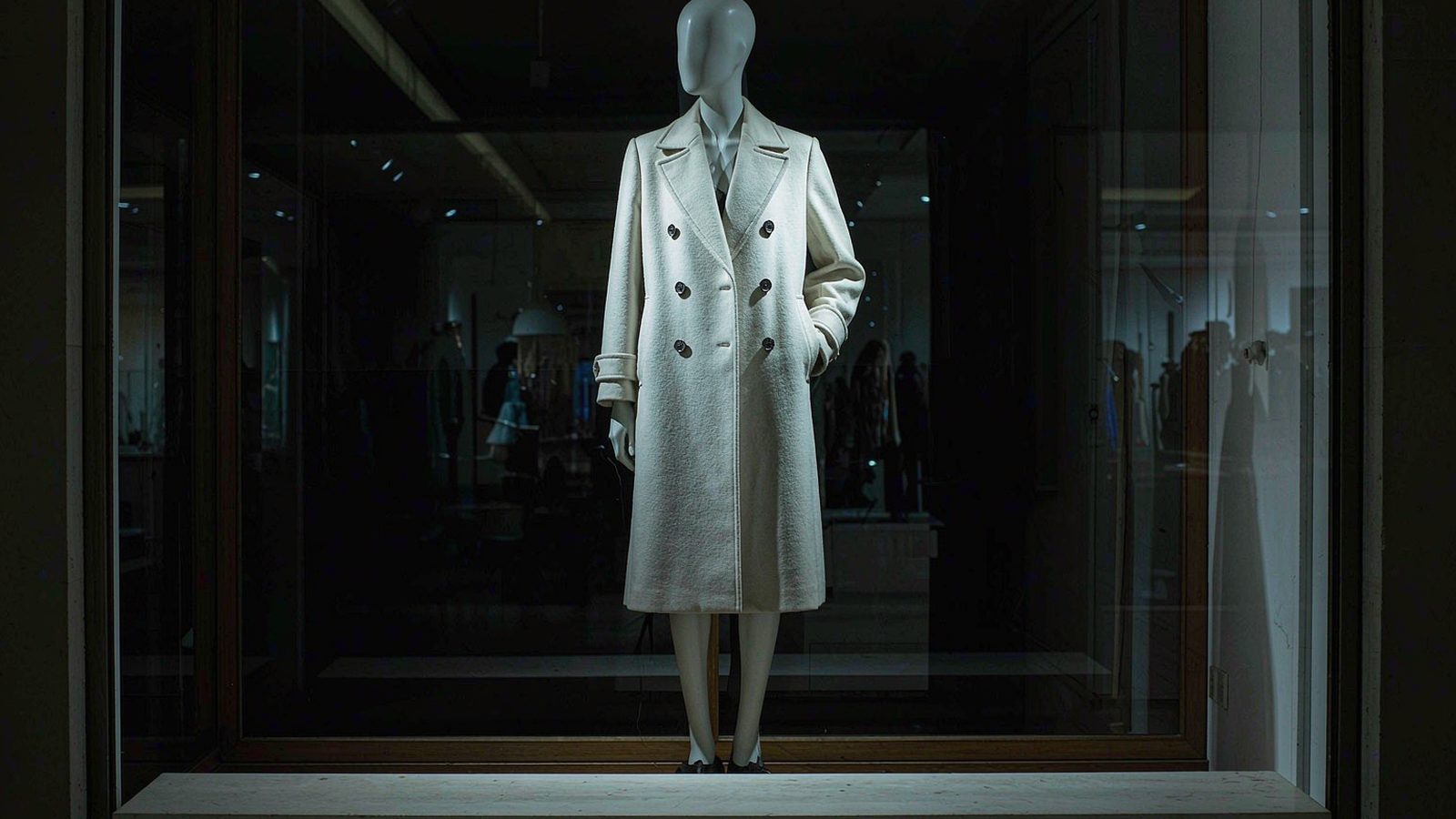
Every window problem looks like a mannequin problem and is almost never one. The number of figures you can use, the poses that will read and even the colour you should choose are decided by three measurements: glass width, floor depth from glass to back wall, and the height of the ceiling or the top of the glass.
A 4 m wide window with 900 mm of floor depth holds three figures comfortably. The same width with 1,800 mm of depth holds five, because the back row becomes visible. The same width with a 2,200 mm ceiling and a low glass line holds two, because anything taller than the sight line is cut off.
| Type | Viewing distance | Figures at 4 m width | Lighting | Watch out for |
|---|---|---|---|---|
| Sealed glass on the street line | 2–5 m | 2–4 | Track spots inside the glass, 3000–3500K | Reflections. A spot aimed at 45° upward bounces off the glass and hides the display |
| Open front no glass, walk-through frame | 1–3 m | 1–2 | Ambient plus one accent per figure | Sight lines break as people pass. Fewer, larger gestures beat detail |
| Semi-open glass on two or three sides | 3–8 m | 3–5 | Overhead wash plus rear accent | The rear face is lit by the shop, front by the street. Colour reads differently from each side |
Step two
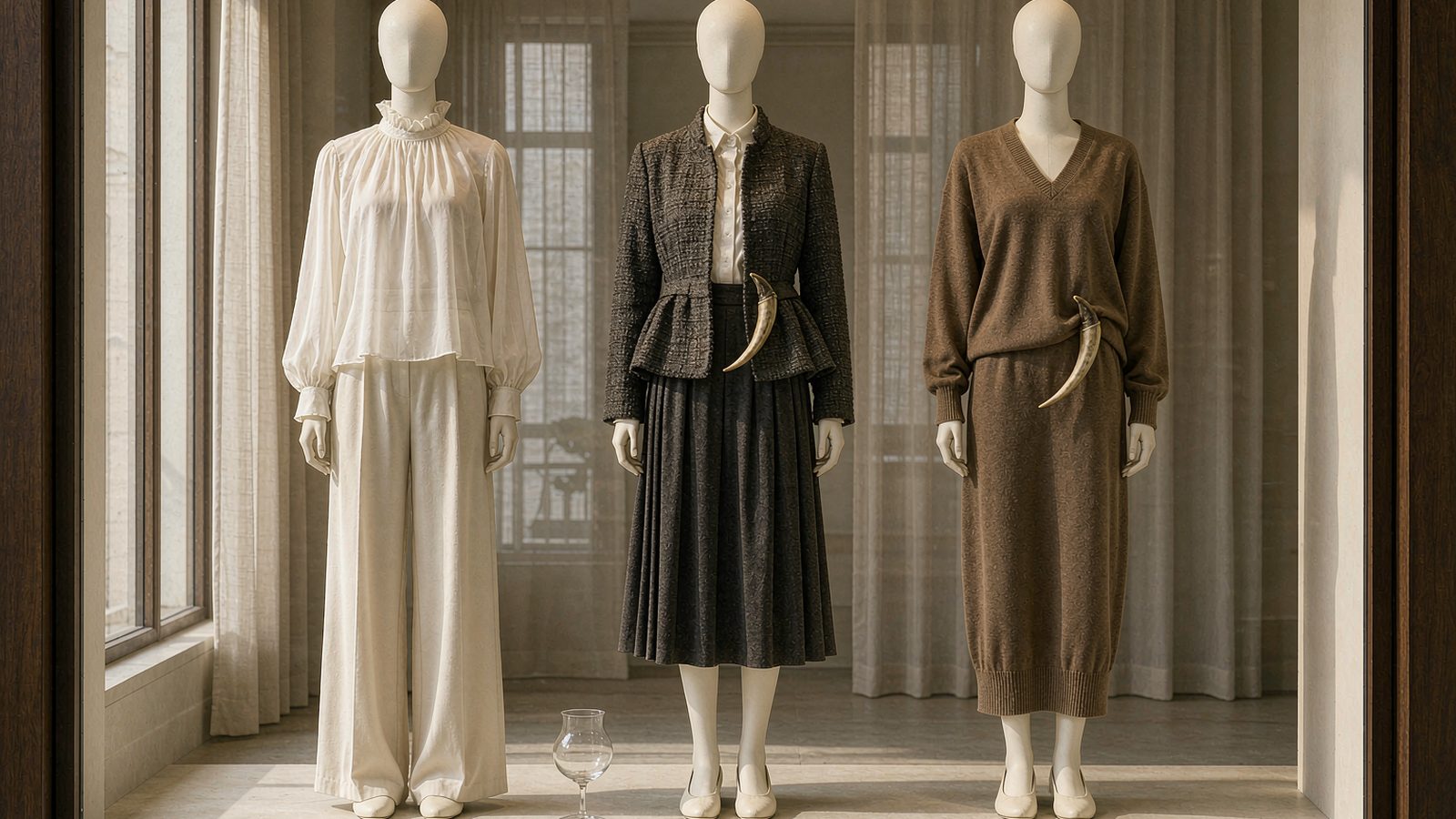
Spacing is not a matter of taste. Figures placed closer than roughly half their own height read as one mass; figures placed further apart than their height stop relating to each other at all. The working rule is a gap of 0.6 × figure height, measured between centres.
For an adult figure that lands at roughly a metre; for a child figure it is closer to two thirds of that. The exact number matters less than applying it consistently — a window looks designed when every gap obeys the same rule, and filled when each one is eyeballed.
Apply the ratio, not a table. Measure the figure you are actually using, multiply its height by 0.6, and that is the gap between centres. Two figures of the same height use the same number; a taller figure takes a wider gap. Working in ratios means the rule still holds when you switch between a child figure and a tall male in the same window.
The count people regret is the fifth figure. Each additional mannequin costs roughly USD 110–130 plus styling time, and pulls attention away from the others. If the window needs a fifth figure to tell the story, the story is too complicated for a window.
Step three
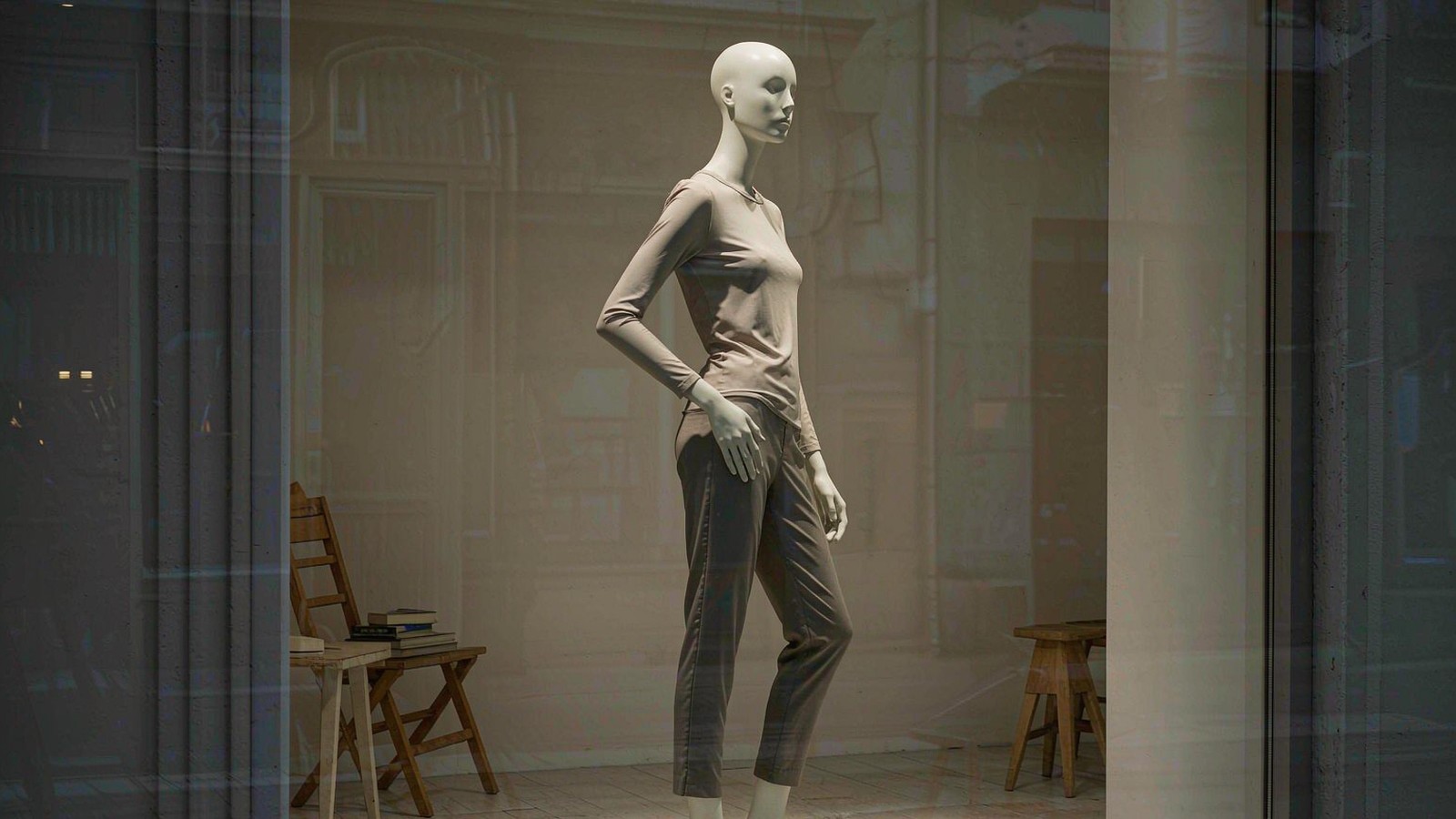
Pose is a legibility decision. At 5 m, a viewer resolves a silhouette, not a gesture. At 2 m they resolve hands. Since most people pass at 2.5–4 m, poses need to work as silhouettes first.
Three hand rules. One: never point a hand at the glass — it reads as an instruction to leave. Two: keep hands below shoulder height in a sealed window, or the upper arm will be clipped by the frame. Three: if two figures are close together, give their hands different jobs; identical hand positions make the pair look like a mirror.
The core asset
Production takes 2–4 weeks after you approve pose and colour. Sea freight to the US east coast, the US west coast or northern Europe takes 5–6 weeks door to door, plus customs. Add two weeks of buffer for a re-spray or a missed vessel and the real number is ten to twelve weeks before the window opens.
The table below works backwards from that. The "order by" column is the last date that keeps sea freight viable; after it, the options are air freight at three to four times the cost, or a stock model in a different colour.
| Month | Window theme | Figures | Suggested figures | Order by |
|---|---|---|---|---|
| January | New-year reset, tailoring | 2–3 | Standing adult pair, matte white | Mid-October |
| February | Valentine, spring preview | 2 | Staggered pair, gloss finish | Early December |
| March | Spring colour | 3 | Trio with one torso form | Late December |
| April | Light layers, transitional | 3 | Trio, one walking | Late January |
| May | Summer preview | 2–3 | Sitting plus standing | Late February |
| June | Sale and holiday | 2 | Minimal pair, headless | Late March |
| July | High summer | 2 | Single plus torso | Late April |
| August | Back to school | 3–4 | Kids trio, low-medium-high | Late May |
| September | Autumn layering | 3 | Adult trio, matte | Late June |
| October | Halloween | 2–3 | Black figures, single spot | Late July |
| November | Christmas install | 3–5 | White or heritage palette | Late August |
| December | Holiday peak | 3–5 | Same set, restyled | Late September |
Rule of thumb for the peak seasons. Christmas is ordered in August, Halloween in July, back to school in May. Every year, shops order in September for a November install and pay air freight for the privilege. Back to school sizing, Halloween themes and Christmas themes each go deeper.
Step four
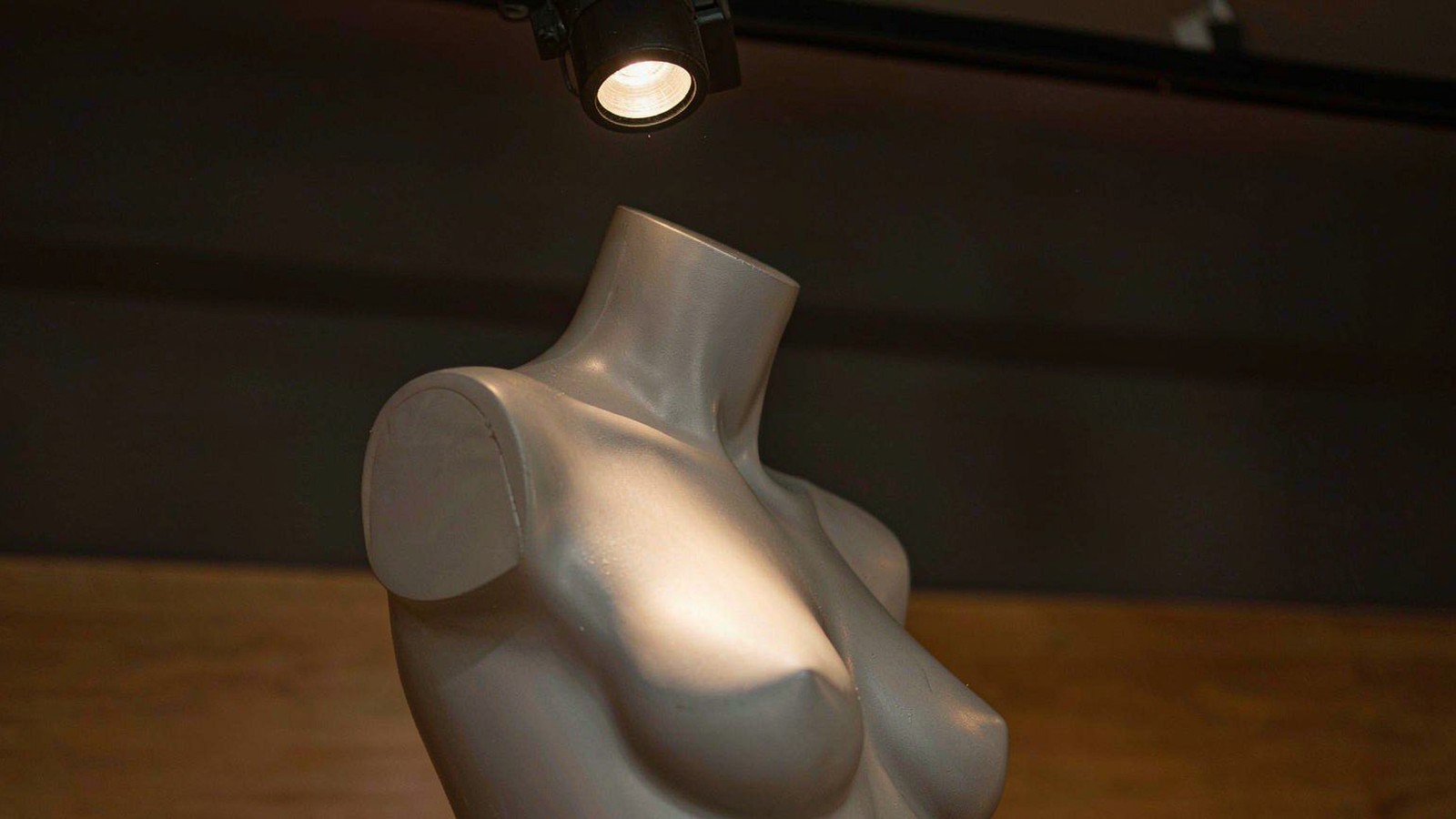
Mannequin colour is chosen under one light and judged under another, which is why windows that looked right in the workshop look grey on the street. Two numbers matter: colour temperature and beam angle.
3000K (warm) flatters skin-tone and gold finishes and makes white fibreglass look creamy. 4000K (neutral) keeps white reading as white and suits matte and semi-abstract figures. Mixing the two in one window is the most common reason a display looks dirty — the eye corrects for the brightest source and everything else shifts.
Beam angle decides whether you see a figure or a hotspot. A 24° beam at 2.5 m gives a pool about 1 m across, roughly one figure. A 36° beam covers a pair. Aim the beam at the shoulder, not the face: a lit shoulder reads as a person, a lit face reads as a mask.
Worked examples
Three real configurations, priced at the standard adult figure rate. Figures are indicative and exclude props, freight and installation labour.
| Window | Size | Figures | Props | Figure cost |
|---|---|---|---|---|
| The minimal pair sealed, gloss white | 2.4 × 1.2 × 2.6 m | 2 | One plinth at 200 mm, no other props | USD 220–260 |
| The tailoring trio sealed, matte | 3.6 × 1.5 × 2.8 m | 3 | Two plinths, one hanging rail behind glass | USD 330–390 |
| The season five semi-open corner | 5.0 × 2.0 × 3.0 m | 5 | Two plinths, one prop cluster, one bench | USD 550–650 |
The smallest of the three is the one that most often wins on the street, because it finishes in under an hour, can be changed monthly without a fitter, and leaves two thirds of the glass empty.
The smallest of the three is the one that most often wins on the street, because it finishes in under an hour, can be changed monthly without a fitter, and leaves two thirds of the glass empty.
Questions
Every four to six weeks for a fashion shop, and at least every season for anything else. Regular shoppers stop seeing a window after about five passes; the change does not need to be expensive, it needs to be visible from the street.
Only with the right finish. Standard fibreglass with a matte or gloss topcoat is an interior product. For a covered outdoor position, specify a UV-stable automotive-grade clear coat; for full exposure to rain and sun, plan on re-coating every 18–24 months.
White and pale figures yellow slightly under sustained UV; dark and gold finishes hold their colour longer. If a window takes direct sun for more than four hours a day, ask for the UV-stable clear coat and rotate the display every eight weeks.
Most window figures stand on a weighted base — glass, iron (round, square or tripod), or timber — with a felt or silicone pad, and need no fixing at all. Where building rules require it, a stainless base can be bolted through the floor; that is a landlord conversation, not a mannequin one. Which material suits which floor is covered in the bases and stands guide.
We supply; we do not rent. For a one-off event, a local prop house is usually cheaper than buying. For anything that repeats annually — Christmas, Halloween, back to school — buying pays for itself by the second or third season.
Minimum order is 5 pieces per model, and poses can be mixed within that. Production is 2–4 weeks after you approve the pose and colour, depending on quantity and on how complex the pose and finish are. Custom poses need a new mould: 3D printing, mould making and the sample are charged, and the tooling cost is credited against the bulk order when it is placed. Payment is 30% deposit with the balance before shipment.
Send the glass width, floor depth and ceiling height. We will send back a figure count, a pose mix and a delivered cost, usually within two working days.
CONTACT US
ART WING Display Mannequin, a China manufacturer of high-end-mid mannequins.
We dedicated to innovative design and focus on producing high-quality display production.
QUICK LINKS
PRODUCTS
ABOUT ART WING
SERVICE

Tel: +86-0769-33218711
E-Mail: info@ysydisplay.com
Add: A1#807, Tianan cyber building, Huangjin Road, Nancheng, Dongguan, China 523000.
Copyright © 2026 DongGuan Art Wing Display Co., Ltd | All Rights Reserved
Hello, please leave your name and email here before chat online so that we won't miss your message and contact you smoothly.