Tel: +86-0769-33218711
E-Mail: info@ysydisplay.com
Add: A1#807, Tianan cyber building, Huangjin Road, Nancheng, Dongguan, China 523000.



Bases & stands
Three materials, three shapes, and the numbers that decide whether one person can move a figure across a shop floor. Glass is tempered, 8 mm and round in most orders; iron comes round, square or on three legs; timber comes round or square.
Materials3Glass, iron, timber
ShapesRound, square, tripodRound standard; square in iron, timber or to order in glass; tripod in iron
Weight with base17.6–19.6 kgFemale 17.6 kg, male 19.6 kg
Packed volume0.2 CBM1 piece per carton, 114×44×38 cm
What we make
Almost every mannequin problem that ends in "it fell over" or "it scratched the floor" starts with the wrong base. Glass, iron and timber are not interchangeable: each comes in a fixed set of shapes, and the shape decides which poses it will hold.
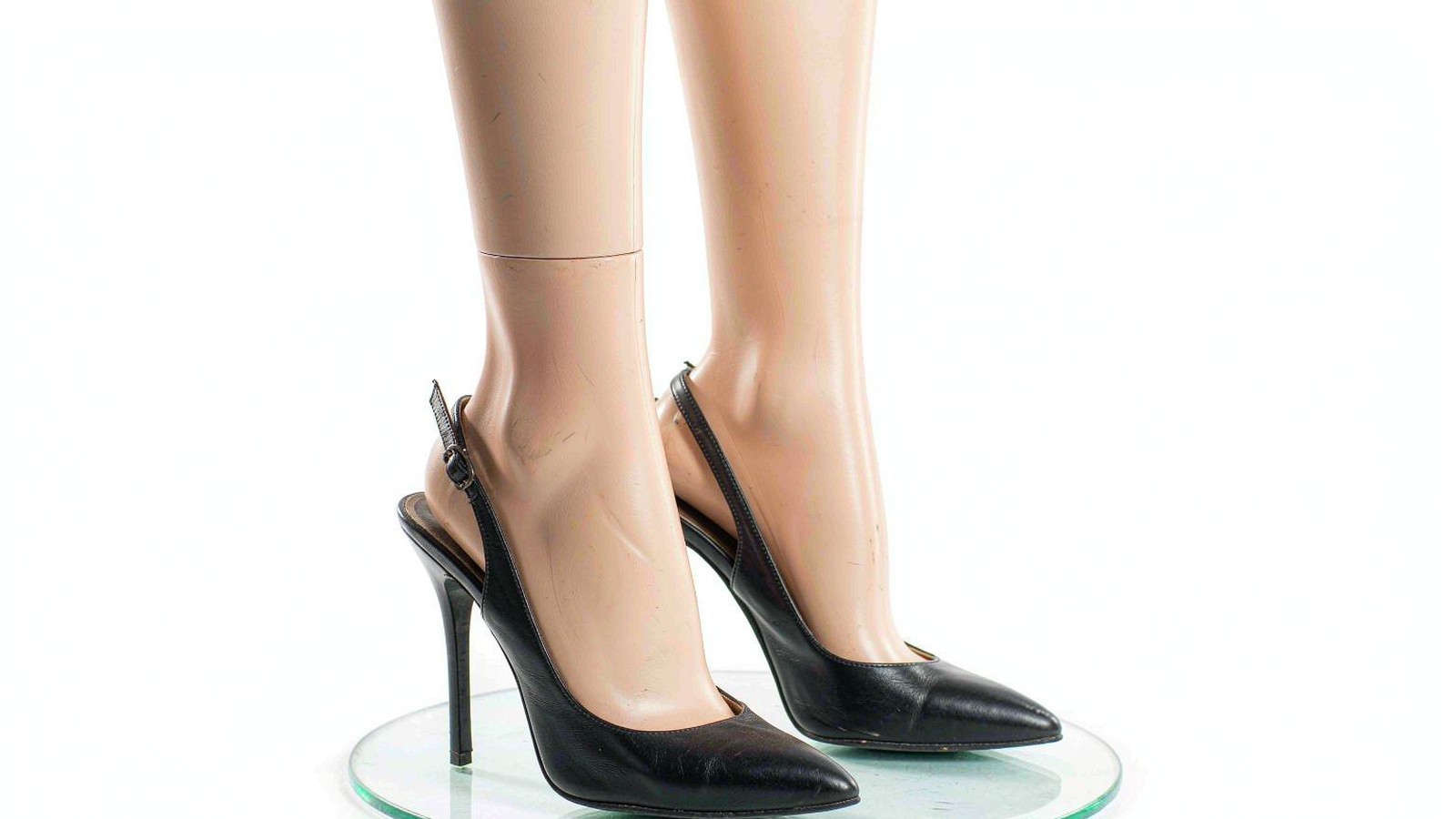
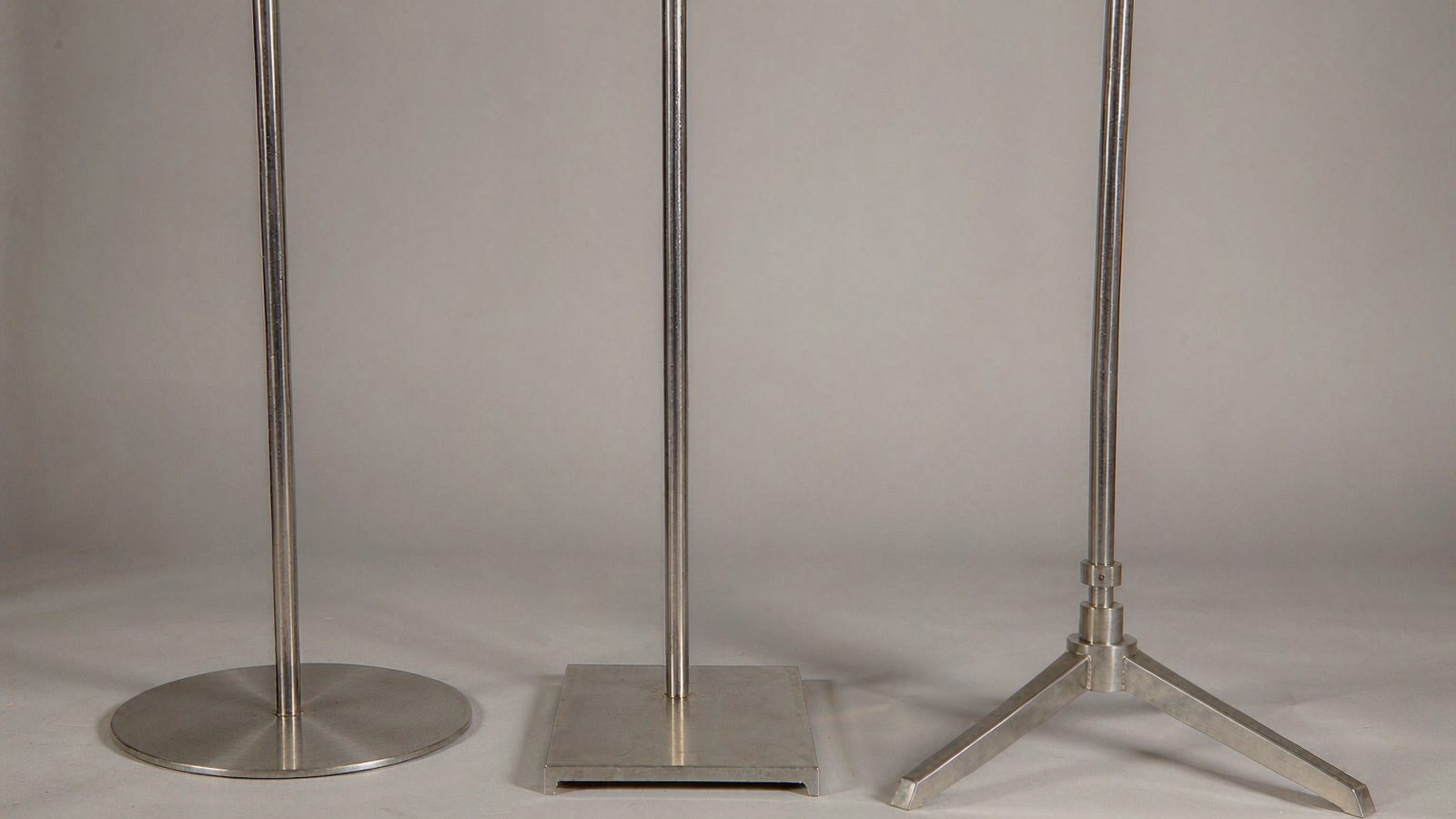
Glass is normally a round disc in 8 mm tempered safety glass, which is the standard for our fibreglass figures; square glass can be made to order, but it is the exception rather than the rule. Iron is made round, square, or as a three-leg stand — the widest footprint of the three. Timber is made round or square.
| Material | Shapes | Stability | Best floor | Watch out for |
|---|---|---|---|---|
| Glass 8 mm tempered, clear | Round; square to order | Good for upright standing poses on a flat, level floor. Light, so it slides rather than grips | Polished stone, tile, pale timber | Chips at the edge on impact; shows every footprint |
| Iron stainless-clad, brushed or polished | Round, square, tripod | Highest of the three. The tripod holds walking and seated poses; the square holds a leaning figure better than a round disc | Any, including low-pile carpet and high-traffic floors | The weight is felt when moving it; a bare iron edge marks lacquer floors. Finishes: brushed, chrome, gold plated or powder coated |
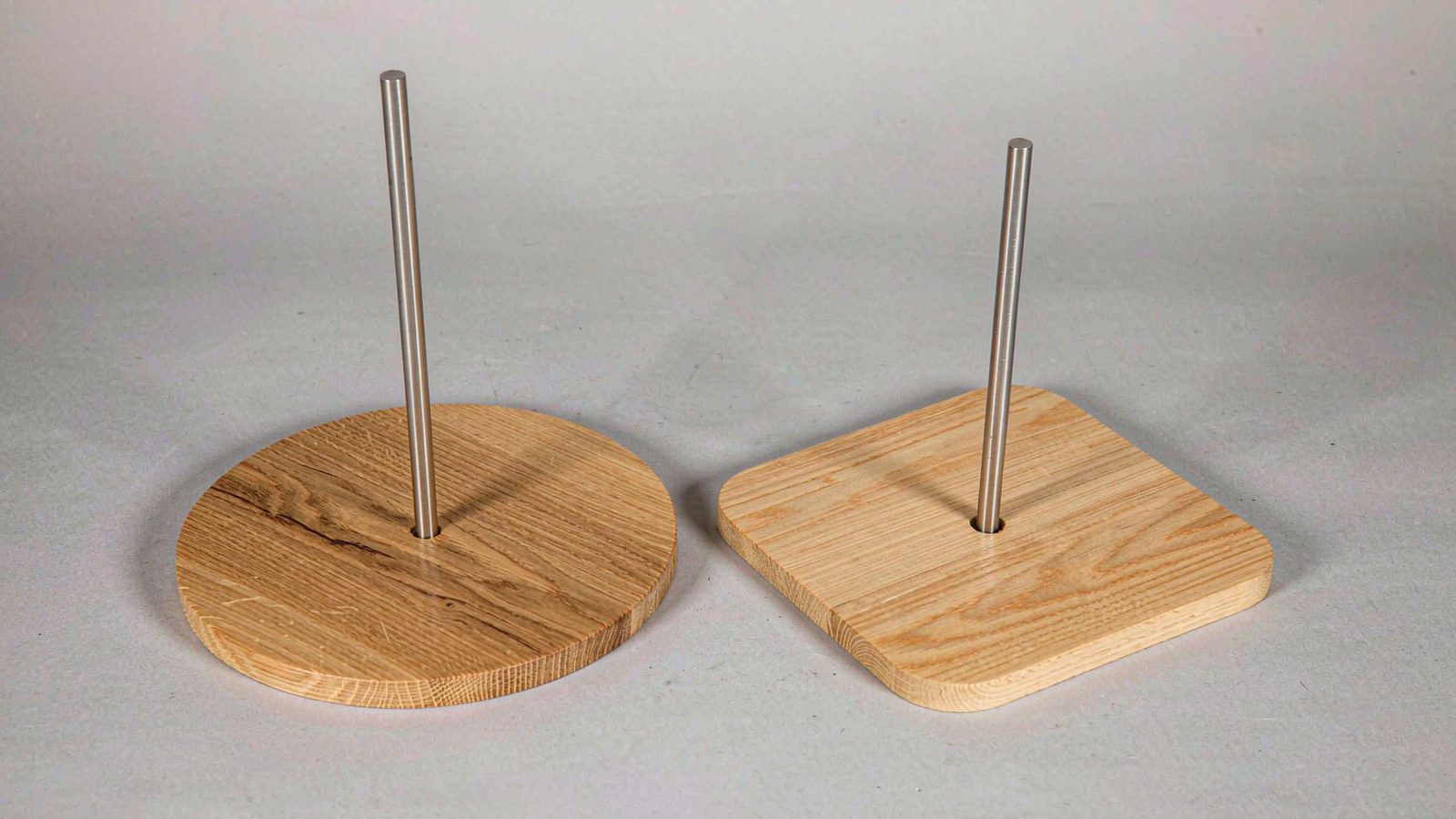
| Timber solid oak or painted hardwood | Round or square | Good for standing poses; warmer in tone than metal or glass | Timber, carpet, boutique interiors | Dents on impact, and it moves with humidity; can be sanded and refinished |
Matching
A figure's centre of gravity moves with its pose, and the base has to sit under it. With three shapes to choose from, the decision is usually made for you by the pose.
Test before you install. Stand the dressed figure on its base and push it at shoulder height with one finger, firmly. It should rock and settle, not tip. If it tips, the shape is wrong for the pose — and it will tip in the shop, usually in front of a customer.
The numbers
This is the data buyers ask for right after the price: how heavy is it and how big is the carton. Figures ship one per carton, with the base packed alongside the body.
| Item | Value | Why it matters |
|---|---|---|
| Pieces per carton | 1 | One figure and its base, never mixed cartons |
| Carton size | 114 × 44 × 38 cm | Sets the pallet build and the door width on delivery |
| Carton volume | 0.2 CBM | Container loading and freight quotes are calculated from this |
| Gross weight, female figure | 17.6 kg | One person can carry and position it |
| Gross weight, male figure | 19.6 kg | Two people for repeated moves, one for a single placement |
Container loading is quoted per order rather than from a formula: how many pieces fit depends on how the cartons are turned, whether they are palletised, and how the bases are packed. Send us the destination and the quantity and our sales team will calculate the load for that shipment.
Weight includes the base. A glass disc and an iron tripod do not weigh the same, so the figure-plus-base weight moves by a kilogram or two depending on what you pick. If one specific figure has to be carried upstairs by one person every week, ask us for the weight of that exact combination rather than the range.
Floor safety
A 19.6 kg figure on a disc puts its whole weight through a small contact patch. On a soft finish that is enough to mark within weeks — and a marked floor costs more to fix than every base in the shop. The pad matters more than the material, but the material decides which pad.
| Floor | Pad | Best base | Why |
|---|---|---|---|
| Oiled or lacquered timber | Felt, 3–5 mm | Timber or glass | Felt spreads load and slides without scuffing; a bare iron edge marks lacquer |
| Polished stone or tile | Silicone, 2–3 mm | Glass or iron | Grips without staining; trapped grit under a hard base is what scratches stone |
| Carpet, low pile | None, or a wide disc | Iron tripod | Carpet absorbs load, so a light disc sinks and the figure looks unstable |
| Polished concrete | Silicone or felt | Any | Hard and forgiving; the risk is sliding, not marking |
Glass needs a level floor, not a hard one. A glass disc on a slightly uneven surface rocks, and a rocking figure reads as broken even when it is not. Check the floor with a spirit level before choosing glass for a window.
Finishes
Finish decides whether the base disappears or becomes part of the composition. A base that matches the floor vanishes; a base that contrasts becomes a design element you have to justify.
Six powder-coated colours are kept in stock on the iron bases. Everything else — any other RAL colour, gold plating, chrome — is made to order, and the lead time is quoted with the order rather than fixed.
Glass — 8 mm tempered, clear — round is standard, square is made to order. Disappears entirely on pale floors. Tempered because a base takes knocks at floor level, and safety glass breaks into blunt pieces rather than shards. The default for minimal windows and light figures.
Iron — brushed — hides fingerprints and reads as equipment rather than decoration. The practical choice for high-traffic shops.
Iron — polished chrome — mirror finish, suits gloss figures and modern interiors; shows every mark from two metres.
Iron — gold electroplated — a polished brass tone plated over iron, on both the square plate and the tripod. It is plating, not solid brass: the look without the weight or the price, and it needs the same care as chrome.
Iron — powder coated — six colours are kept in stock, and we send the swatches with the quote so you can choose against your own floor and fixtures. Any other RAL colour is coated to order, which adds to the lead time. This is the route to a tripod that is not gold or chrome: it can be coated to the same colour as the round and square bases, or to a brand colour.
Timber — natural oak — warm, and the only finish that improves with wear. Pairs with realistic figures rather than abstract ones.
Timber — painted to RAL — lets the base match a brand colour or disappear into a painted floor. Available on both the round and the square timber base.
Finish is not tied to shape. All four iron finishes — brushed, polished chrome, gold electroplated and powder coated — are available on the round, the square and the tripod. The tripod is not limited to gold and chrome; a black or painted tripod is a normal order, and it is what you want if the stand is meant to disappear against a dark floor. The six stock colours ship inside the standard 2–4 week production window; anything outside them is quoted with its own lead time.
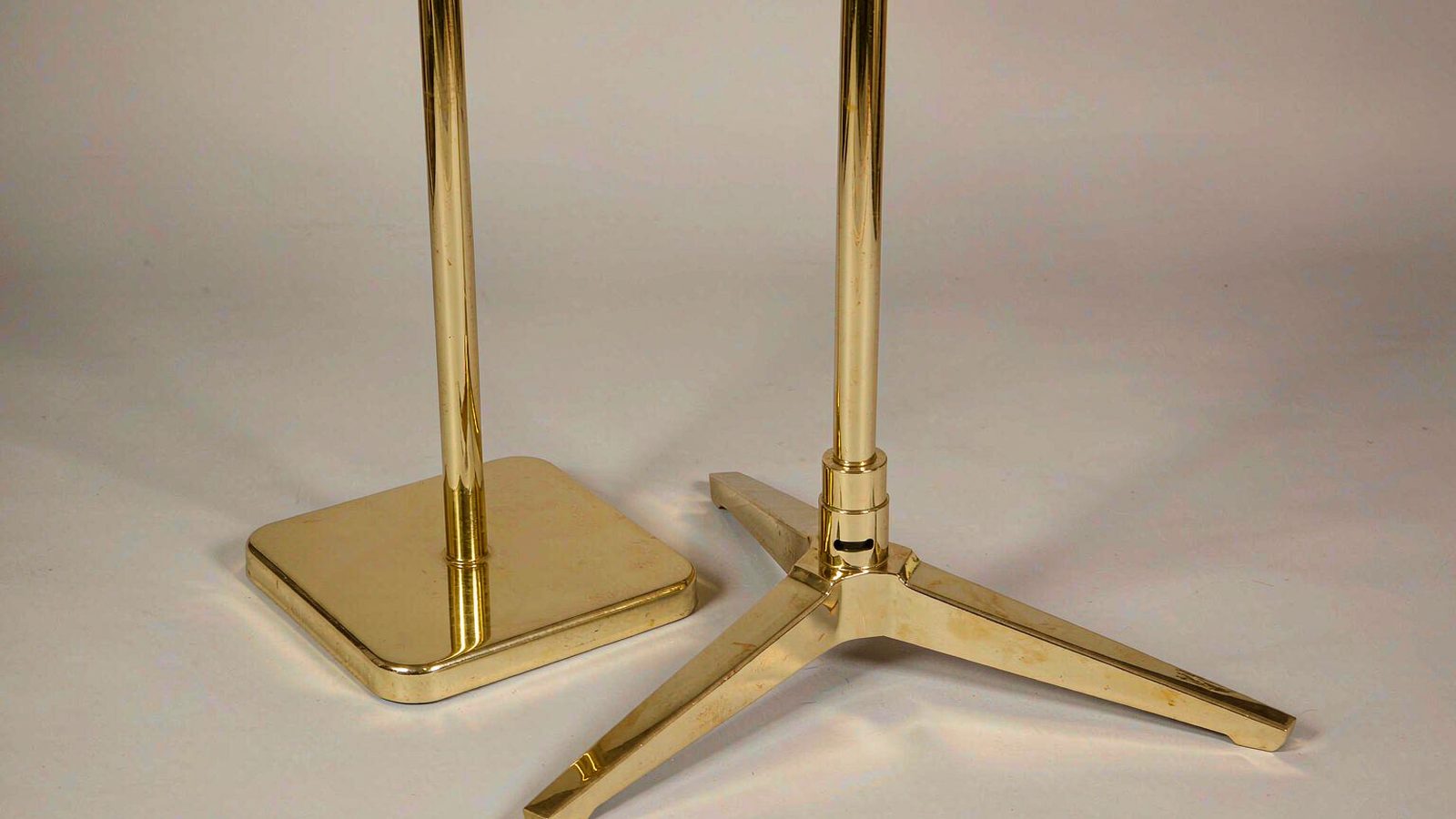
Gold is plating, not brass. Buyers often assume a gold base is solid brass. It is electroplated iron, which keeps the weight and the cost down and matches a gold-finished figure exactly. Clean it like chrome — a damp cloth only, no abrasive polish, which wears through thin plating at the edges first. If you need a colour other than gold or chrome, that is powder coating rather than plating.
Questions
Yes. Bases are sold separately so that one base can serve several figures across a season, and so you can change the look without replacing the figure. Minimum order quantities apply as they do to figures.
The iron tripod. Both poses push load sideways rather than straight down, and the three legs give the widest footprint of the three shapes. A round glass or timber disc will tip or walk across the floor under that load. Any of the three iron shapes can be brushed, chromed, gold plated or powder coated to a colour.
17.6 kg for a female figure and 19.6 kg for a male, base included, packed one piece per carton of 114 × 44 × 38 cm, which is about 0.2 CBM. The figure moves by a kilogram or two depending on which base you choose.
Yes. The standard is 8 mm tempered safety glass, which is what our fibreglass figures ship with. Tempered matters at floor level: if a base is kicked or dropped it breaks into blunt pieces rather than shards, and it takes a knock that ordinary glass would not. Thicker glass is available on request, but 8 mm is what most orders use. Round is the standard shape; square glass is made to order.
Six powder-coated colours are held in stock, and they cover most orders. Any other RAL colour is coated to order: it is the same base and the same finish quality, but the coating is scheduled into the next batch, so the lead time is quoted per colour rather than fixed at the standard 2–4 weeks.
Not on their own — trapped grit underneath does. A felt pad under timber and glass, and a silicone pad under iron on stone, removes almost all of the risk. Dragging any base sideways with weight on it is what leaves marks.
Across our own range, yes: the foot fitting is standardised, so a figure can be re-based when the styling changes. Between brands, no — rod diameter and plate height differ, and a base that does not seat flat will make the figure lean.
Send us the pose, the floor type and a photograph of the space. We will tell you which material and shape holds it, and the pad that goes underneath.
CONTACT US
ART WING Display Mannequin, a China manufacturer of high-end-mid mannequins.
We dedicated to innovative design and focus on producing high-quality display production.
QUICK LINKS
PRODUCTS
ABOUT ART WING
SERVICE

Tel: +86-0769-33218711
E-Mail: info@ysydisplay.com
Add: A1#807, Tianan cyber building, Huangjin Road, Nancheng, Dongguan, China 523000.
Copyright © 2026 DongGuan Art Wing Display Co., Ltd | All Rights Reserved
Hello, please leave your name and email here before chat online so that we won't miss your message and contact you smoothly.