

How to Choose Kids Mannequins: Sizing, Safety and Display Planning for Childrenswear Retail
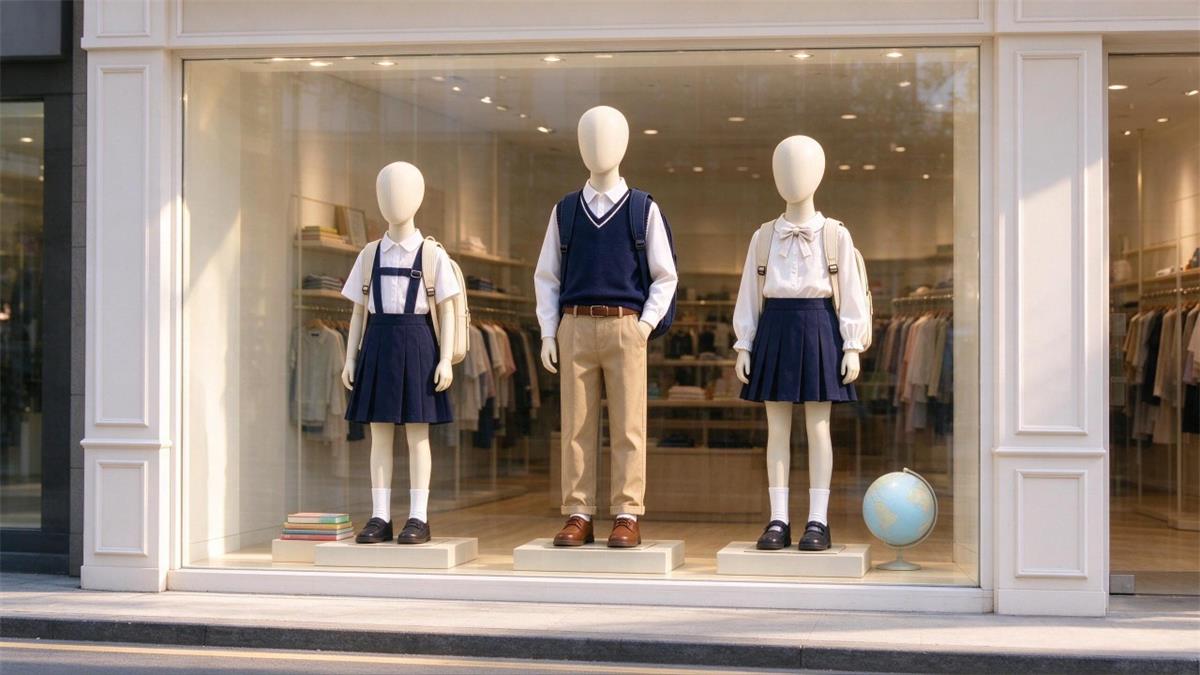
Kids mannequins are display forms built to the proportions of specific child age bands, and choosing them well comes down to three decisions: which age band your best-selling sizes sit in, which form type your floor can dress efficiently, and whether the base can stay upright when children are in the room. Get them right and the forms sell complete outfits; get them wrong and a toddler form in a size 8 jacket teaches the customer nothing about fit. This guide covers how to choose kids mannequins for a childrenswear store: sizing bands from infant to pre-teen, the form types that earn their floor space, quantity planning by store format, the safety checks that matter when kids can reach the display, and a calendar anchored to the two peaks in childrenswear retail, back to school and the holiday gifting season.
What makes kids mannequins different from adult forms?
An adult form can serve a broad size range because adult proportions change slowly. A child form cannot. Proportions shift dramatically year over year, so a form labeled for a four-year-old and a form labeled for an eight-year-old are not just different heights, they are different silhouettes: larger head relative to body, shorter limbs, rounder torso in the younger bands, then a rapid lengthening of the legs somewhere around age eight. A size 4T and a size 10 are not the same shape scaled up.
The second difference is the audience. Childrenswear sells to two people at once. The parent decides and pays, the child influences and often chooses. That changes what the display has to do: the parent needs to see fit, fabric and styling clearly, while the child needs a form that looks like a kid rather than a small adult. The complete mannequin selection guide covers the full decision framework for any store, and the boutique mannequin guide covers format-specific choices. This article stays on the kids floor.
How do you match kids mannequins to the age groups you sell?
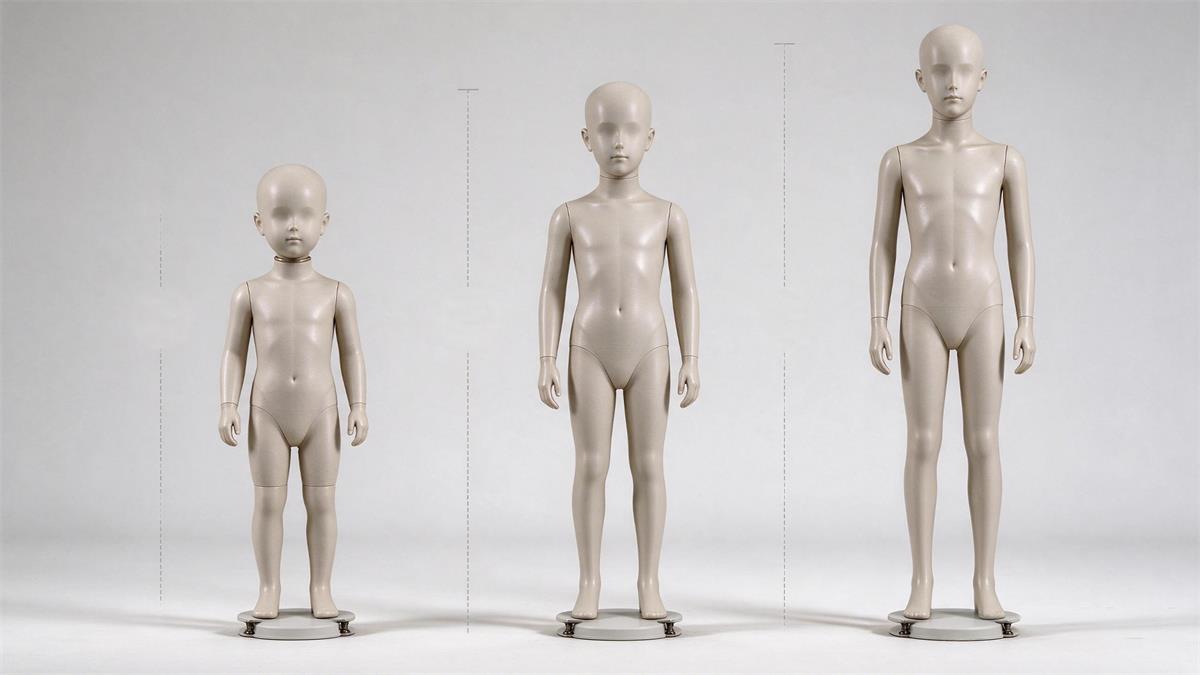
Start from your size run, not from the mannequin catalog. Count the units you sell by size band over a season, then buy forms for the two or three bands that carry most of the volume. Most childrenswear stores find that the middle bands, roughly four to ten years, do the work, because those sizes turn over fastest and parents buy complete outfits rather than single pieces.
The table below shows typical industry ranges for form height by age band. Treat them as a planning anchor, not a spec, and confirm actual body measurements against your own inventory before ordering, because age labels vary between suppliers.
| Age band | Typical form height | Garment sizes it presents | What displays best |
|---|---|---|---|
| Infant, 0 to 24 months | 20 to 34 in | 0-24M bodysuits, rompers, sleep sets | Lay-flat or seated props, since soft goods drape best horizontally |
| Toddler, 2 to 4 years | 34 to 39 in | 2T to 4T sets, dresses, light outerwear | Standing and seated, layered sets read clearly |
| Young child, 4 to 7 years | 39 to 47 in | Sizes 4 to 7 | Full head-to-toe outfits, the first band with true standing poses |
| Older child, 7 to 10 years | 47 to 55 in | Sizes 8 to 10 | Outerwear, graphic tees, activewear |
| Pre-teen, 10 to 14 years | 55 to 62 in | Sizes 12 to 14 | Fashion-led looks, proportions approach adult forms |
Why the label age matters less than the measurements
A form sold as a "6 year old" can vary by several inches between suppliers, and the same supplier's forms can be sculpted to garment size rather than to body size. The measurement that matters is whether a best-selling dress or jacket fits the form the way it fits the child it was cut for. Ask suppliers for the form's actual shoulder, chest, waist and height measurements and compare them with your own size chart, the same way the mannequin size chart matches forms to real customers. One tape measure check at receiving prevents a season of distorted displays.
Which form types work best in a childrenswear store?
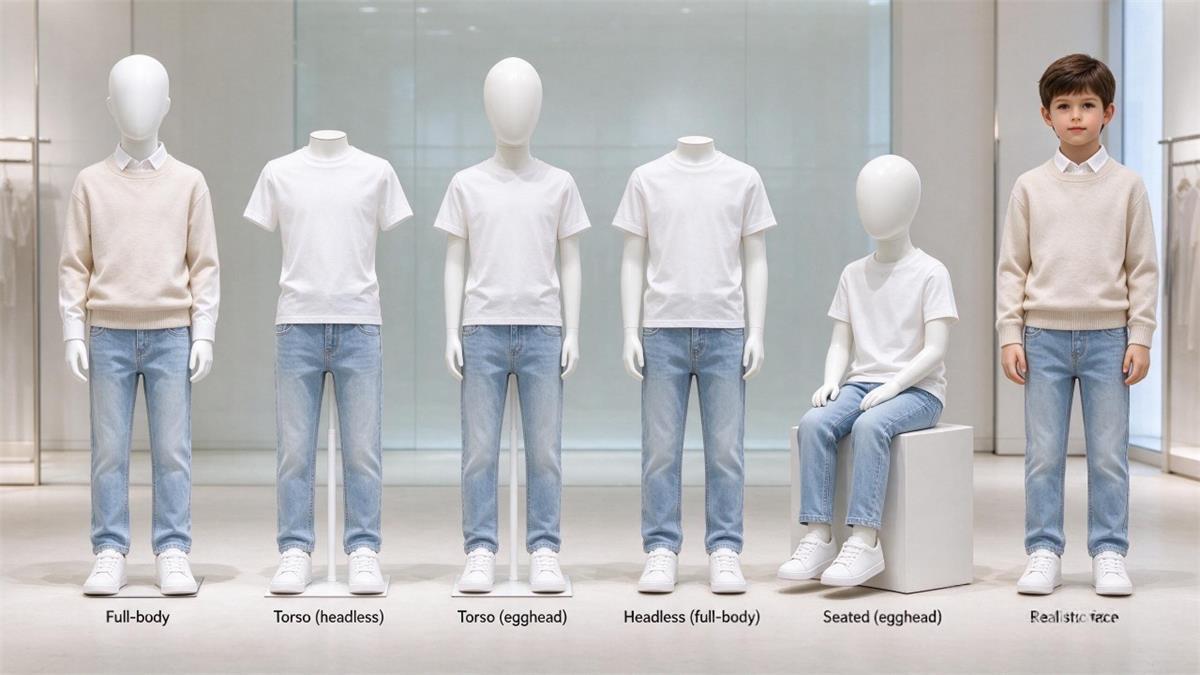
Kids floors change outfits far more often than adult floors, because children outgrow garments mid-season and the story turns over with the school calendar. Choose forms by how often each piece gets dressed, not just how it looks in the window. The types of mannequins for retail display overview covers the full taxonomy, and the comparison below narrows it to what works on a kids floor.
| Form type | What it does best | Trade-offs |
|---|---|---|
| Full-body standing | Complete outfits and window storytelling | Deepest footprint, slowest to dress |
| Torso or half-body | Tops, dresses and small floor zones | Fastest changeovers, no full silhouette |
| Headless | Multi-unit walls and editorial looks | Simplest dressing, less lifestyle warmth |
| Egghead | Balanced focus with a hint of character | Slightly stylized, easy to maintain |
| Seated | Lifestyle vignettes and window scenes | Limits garment range, harder to reset |
| Realistic face | Focal window moments with emotional pull | Needs the most dusting and care |
A practical mix for a small store is one or two full-body forms for the window, a run of torsos for the wall, and one seated or realistic form for a focal vignette. Keep the window forms separate from the floor forms in your budget, because they do different jobs: the window stops traffic, the floor forms convert it.
How many kids mannequins does your store need?
The right count is the number of outfit stories you want to tell at one time, not the number that fills the floor. One form per story, with at least one per age segment you carry, is the framework. Under-buying is the common mistake: three garments crammed onto one form read as a sale rack, while the same three on three forms read as a styled floor.
| Store format | Window forms | Floor forms | Planning rule |
|---|---|---|---|
| Boutique under 1,500 sq ft | 2 to 3 | 3 to 5 | One form per outfit story |
| Mid-size childrenswear store | 3 to 4 | 6 to 10 | At least one per age segment, doubled at peak |
| Kids zone in a department store | 4 to 6 | 10 or more | Group into vignettes by sub-brand or age |
Buy in two waves if budget is tight. Put the first wave at the entrance and in the window, where each form earns the most, and add mid-floor units in the second wave. Review the count each season, because back to school and the holiday weeks usually call for more forms on the floor than a quiet February does.
What safety checks matter when children can reach the display?
This is the section most buyers skip, and the one that protects the store. Children touch displays, lean on them and sometimes try to climb them, so the fixture shares the floor with customers its own height. The numbers behind the risk are not small: the US Consumer Product Safety Commission reports that unstable and unsecured furniture and televisions kill a child every two weeks on average, and estimates about 17,300 children were treated in US emergency departments each year for tip-over injuries between 2013 and 2015, with 489 reported fatalities between 2000 and 2015.
Display mannequins are not clothing storage units and are not covered by the furniture safety standards, but the physics is identical. The voluntary standard behind the CPSC's own rulemaking, ASTM F2057-19, tests stability for clothing storage units 27 inches and taller with a 50-pound load, a weight chosen to represent a 95th-percentile five-year-old. That figure is a useful benchmark when you spec bases for forms that stand within a child's reach.
| Check | What to look for | Why it matters |
|---|---|---|
| Base and stability | A base roughly a third of the form's height or wider, or a weighted base; the form should not shift when pushed firmly at shoulder height | The same tipping forces that move furniture move a lightweight form when a child pulls on an arm |
| Placement within reach | Forms a child can touch get wide bases or stand against a wall, never on a narrow riser at the floor edge | The 50-pound stability benchmark behind ASTM F2057-19 exists because young children climb and pull |
| Parts and edges | No small detachable parts, smooth rounded edges, joints that stay tight under handling | Detachable pieces become choking hazards and sharp edges cut |
| Finish and materials | Supplier documentation of non-toxic, lead-free finishes | Displays get touched and sometimes mouthed, and documentation protects the store |
| Props and accessories | Nothing balanced on a head, hand or shoulder that can fall | A falling prop injures the child, not the form |
A ninety-second stability test you can run on the floor
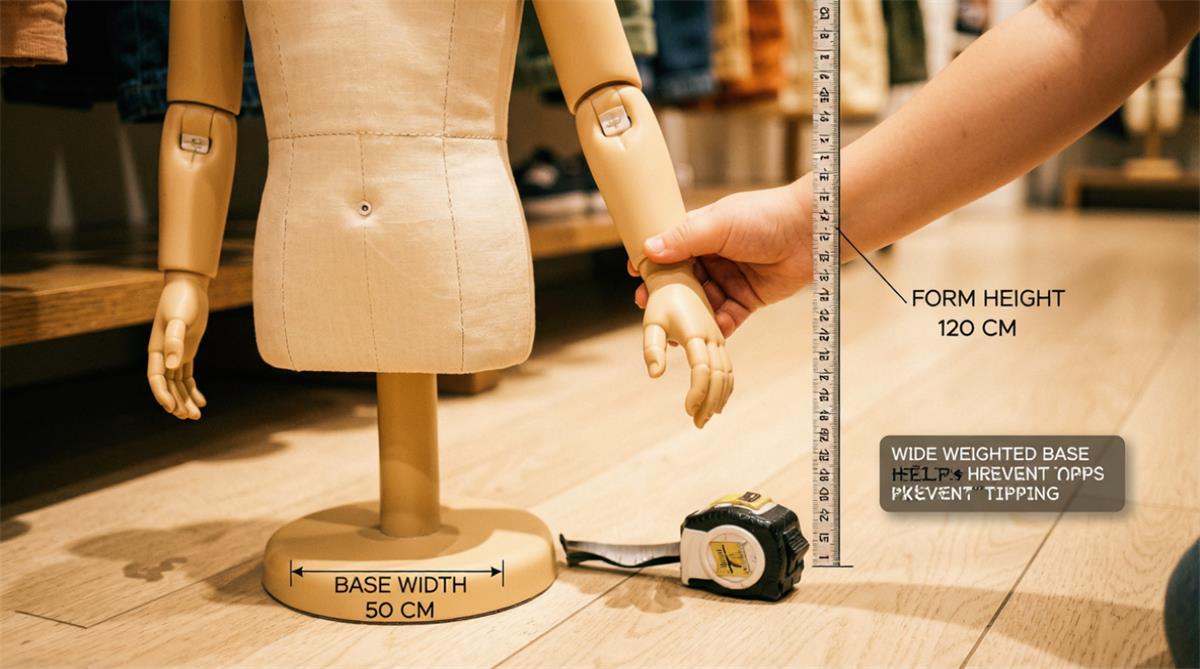
Stand the form in its actual position, dress it, then push firmly at shoulder height with one hand. It should rock slightly and settle, not slide or lift. Then pull down on one arm the way an impatient five-year-old would. If either test moves the form, the base is too narrow or too light for that position; the fix is a wider base, a weighted plate, or moving the form against a wall. Repeat each seasonal reset, because bases loosen.
Which poses, finishes and head styles suit a kids floor?
Poses should carry the energy of the age band you are dressing. For younger children, active poses that suggest running, reaching or kicking match how the clothes are actually worn. For older children and pre-teens, a natural standing pose with arms slightly away from the body is the most versatile choice, because it dresses fast and shows outerwear and layering without compressing the garment. Seated poses work well in window vignettes but limit the range you can show. The mannequin pose selection guide covers matching pose to merchandise in more depth, and the mannequin styling walkthrough covers dressing technique.
Finish choice on a kids floor is mostly a maintenance decision. Matte finishes hide fingerprints and scuffs in a high-touch environment, which matters when shoppers handle product all day. Glossy finishes read as premium but show every mark, so they belong in the window rather than at arm's reach on the floor.
Head style follows the same logic as form type. Headless and egghead forms keep the focus on the clothing, dress faster and are the common choice for multi-unit walls. A realistic face earns its place at a single focal point, usually a window, where the emotional pull of a lifelike child form stops traffic. One realistic face per window is plenty; a wall of them reads as a doll collection rather than a store.
How should you plan the kids display calendar?
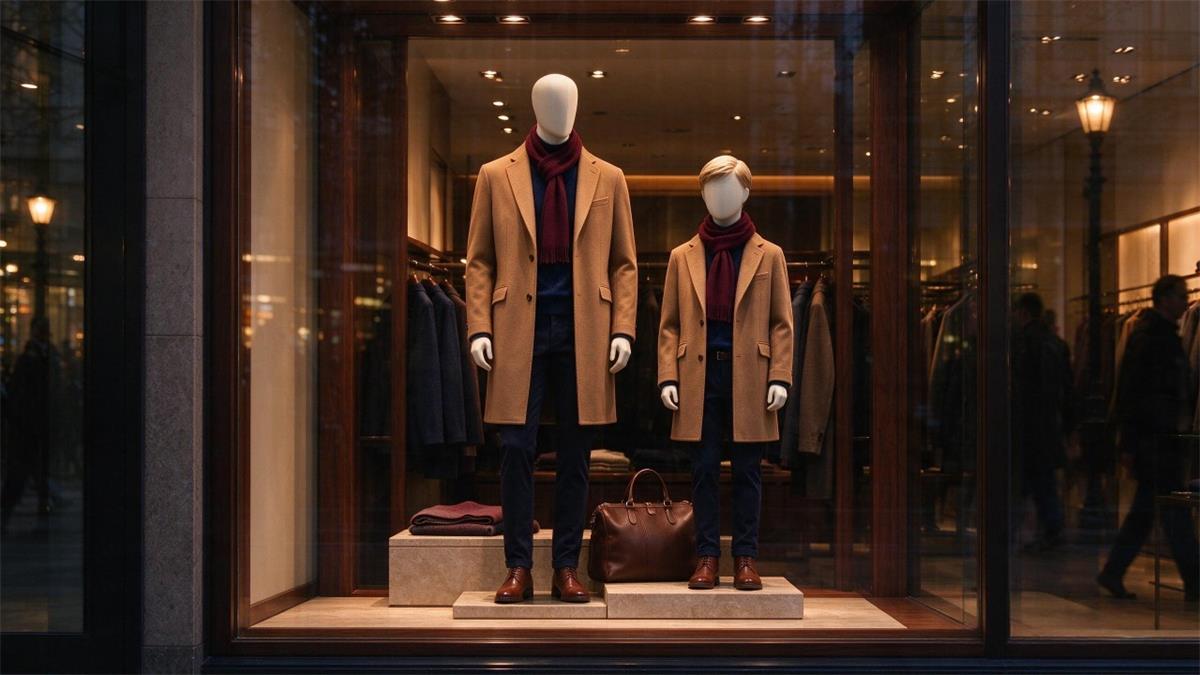
Childrenswear runs on two peaks, and both are visible in national spending data. Back to school is the larger one for most stores: NRF's 2026 survey with Prosper Insights found 62% of shoppers had already started by early July, K-12 households planned to spend an average of $863.86 including $250.29 on clothing and accessories, and total K-12 spending was expected to reach a record $43.3 billion, up from $39.4 billion the year before. Nearly four in ten shoppers used clothing stores. The practical read: your window and floor forms need to be dressed and working by late June, not in August when the customer has already bought.
The holiday peak is a gifting peak. NRF's holiday survey found consumers planned to spend $890.49 per person, with $627.93 going to gifts for family and friends, and Prosper noted that families with children were expected to increase their gift budgets by more than $30 on average. Clothing and accessories were the most-wanted gift category at 46%. With 42% of shoppers starting before November and 63% doing most of their shopping over Thanksgiving weekend, the kids gift window has to be installed and photographed before Thanksgiving week, not after.
| Period | What shoppers are doing | What the kids display should do |
|---|---|---|
| Mid June to early July | Back-to-school shopping starts early | Full back-to-school floor set, window styled with complete outfits |
| Late July to mid August | Peak back-to-school buying | Weekly window refresh, front layer carries new arrivals |
| September | Back-to-school spend done, fall wardrobe starts | Transition to fall layering, keep one age band focal |
| Late October to Thanksgiving | Holiday budgets forming, gift research starts | First gift-ready kids vignette, parent-and-child pairings |
| Thanksgiving to mid December | Bulk of holiday gifting happens | Peak kid gift floor, refresh window every week |
| January | Gift returns and clearance | Reset to neutral base, hold two age segments |
Rotation cadence that keeps the floor fresh
Childrenswear fatigues faster than adult apparel because the size run turns over constantly. A workable cadence is a full outfit change every two to four weeks in season, weekly for the window during the two peaks, and a complete reset between peaks. Write the rotation dates into the same calendar as your buying plan, because a form that still wears July's back-to-school outfit in October quietly tells families the store is behind.
How do you keep kids mannequins looking new?
Kids fixtures take more handling than adult ones, so maintenance is part of the purchase decision. Wipe matte finishes with a damp cloth and mild detergent rather than abrasive cleaners, which scratch the surface. Check base plates, joints and arm hardware monthly, and tighten at the first wobble rather than after a tip. Steam garments before they go on the form and again at each rotation, because wrinkles read as careless on a floor where parents scan for quality.
If the supplier offers spare heads, hands or base plates, buy a small stock with the initial order. A chipped hand on a kids form is not a five-year problem when the fix is a stocked part. Store off-season outfits flat and labeled by size band, so the next season's reset is a dressing job rather than a buying job.
Ready to build your kids display?
Work outward from your size run, and that is how to choose kids mannequins in practice. Pick the two or three age bands that carry your volume, choose form types by how often each gets dressed, buy one form per outfit story with at least one per age segment, and verify every base against the push test before it goes on the floor. Then set the calendar to the two peaks and hold the rotation dates. Browse the kids mannequins collection to see how the age bands and form types sit inside a range, compare them against the female and male mannequin categories if your store runs a mini-me program, and contact the team for a second opinion on sizing or layout before the order goes in.
For the wider selection framework, the mannequin selection guide is the pillar page for this topic, and the dress form display guide covers the lower-depth option when a window cannot carry a full-height form.
About the Author
Charles Yang is a 3D Model Designer at awmannequins.com. With over 6 years of experience in retail fixture 3D modeling and product visualization, he supports retail brands and manufacturers with renders, virtual merchandising, and e-commerce-ready 3D assets.
Frequently Asked Questions
What age range do kids mannequins cover?
Infant through pre-teen, typically from a 0 to 6 month form up to a 12 or 14 year form. Across the industry the middle bands sell best, with forms for roughly six and ten year olds covering the size runs most childrenswear stores stock in the highest volume. Age labels vary by supplier, so verify actual body measurements against your inventory rather than relying on the label.
How many kids mannequins does a small boutique need?
Two or three for the window and entrance, plus three to five for the floor, is an effective start. Fill the highest-visibility positions first, since each form there returns the most, and let the count match the number of distinct outfit stories you want to show. Add units gradually and review the count each season, because back to school and the holiday weeks usually call for more.
Do kids mannequins need to have realistic faces?
No. Realistic faces are an aesthetic choice, not a functional requirement. Headless and egghead forms are common in kids retail because they keep the focus on the clothing and dress faster, while a realistic face works best at a single focal point such as a window, where the emotional pull of a lifelike child form stops traffic. Match the decision to your store identity.
Are flexible or rigid child mannequins better for frequent outfit changes?
Flexible forms with poseable limbs cut the effort of fitting garments with narrow openings, such as fitted dresses or onesies, and reduce seam strain during dressing. Rigid forms demand careful positioning but hold up better in low-turnover positions. Base the choice on how often you plan to change the displayed outfits, not on price alone.
What safety checks matter for kids mannequins within children's reach?
Look for a wide or weighted base, no small detachable parts, smooth rounded edges, and documented non-toxic finishes. Run a simple test: push the dressed form firmly at shoulder height and pull down on one arm; it should rock and settle, not slide. CPSC reports unstable furniture kills a child every two weeks on average in the US, and the 50-pound stability benchmark behind ASTM F2057-19 exists for exactly this reason.