Tel: +86-0769-33218711
E-Mail: info@ysydisplay.com
Add: A1#807, Tianan cyber building, Huangjin Road, Nancheng, Dongguan, China 523000.


Why Ghost Mannequins Are Not Retail Display Solutions
Introduction
In the world of fashion retail, mannequins play an important role in shaping how customers experience clothing in a physical space. A well-styled mannequin can communicate an entire collection in seconds.
But occasionally a misunderstanding appears in retail planning discussions: the idea that ghost mannequins can be used as store display mannequins.
This confusion usually comes from the rise of e-commerce photography.
If you’ve ever seen online product photos where clothing appears to float naturally in shape — with no visible model — you’ve probably seen ghost mannequin photography at work. The technique creates the “invisible mannequin” effect used widely in online fashion stores.
The key point is simple.
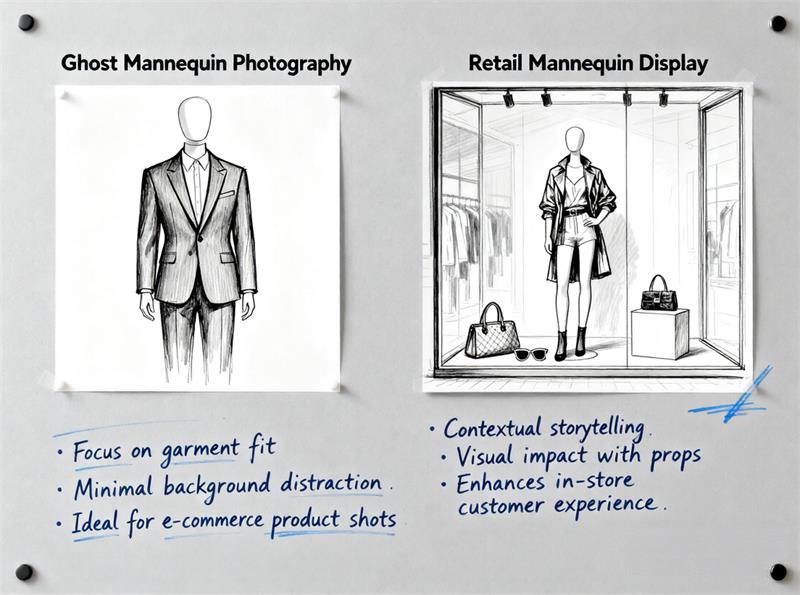
Ghost mannequins are designed for cameras.
Retail display mannequins are designed for people.
Understanding that difference is essential for retail display planning, visual merchandising, and customer experience.
Design Perspective
From a retail design perspective, mannequins serve a completely different purpose than photography tools.
In stores, mannequins help customers imagine how garments move, layer, and fit in real life. They create a human reference point within the store environment.
This often depends on the brand.
Some brands prefer abstract mannequins that emphasize silhouettes. Others choose more realistic forms that create emotional connection with shoppers.
But in both cases, mannequins are part of the visual storytelling of the store.
Ghost mannequins, by contrast, are not designed for that experience. They are usually segmented or simplified to support photo editing, allowing photographers to create the invisible mannequin effect.
From a design perspective, that structure does not translate well into a physical retail environment.
Customers viewing displays from different angles expect mannequins to feel complete and balanced. Ghost mannequins simply were not created with that visual intention.

Display Strategy
Within a visual merchandising strategy, mannequins function as anchors for styling stories.
They show customers how pieces from a collection work together — jackets layered over shirts, accessories paired with dresses, footwear completing the look.
Consider a simple store scenario.
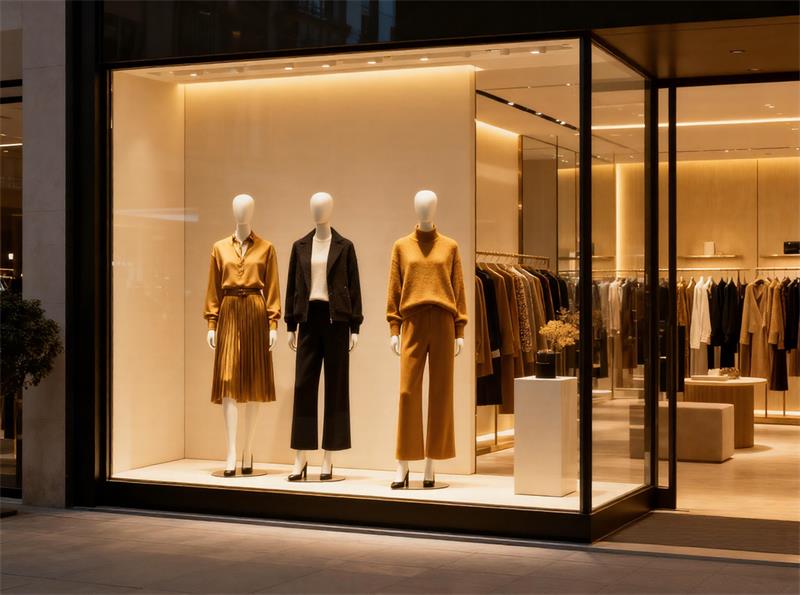
A fashion boutique launches a new seasonal collection. Near the entrance, three mannequins are styled with coordinated outfits representing the key looks of the season.
Customers entering the store immediately understand the theme.
If the same garments were placed on ghost mannequins instead, the presentation would feel incomplete. From certain angles the form might appear fragmented or unnatural.
Lighting changes the effect as well. Under retail lighting, structural gaps or simplified forms become much more visible than they would in a controlled photography studio.
This is why ghost mannequin vs retail mannequin discussions are important in retail planning.
They serve very different roles.
Store Environment
The environment of a retail store also influences how mannequins perform visually.
Stores are dynamic spaces. Customers move around displays, viewing them from multiple directions.
Store layout makes a difference.
In some boutiques, mannequins stand in window displays where they must attract attention from the street. In larger stores, mannequins may guide customers deeper into the space.
Display height matters more than expected.
Mannequins positioned slightly above eye level can remain visible even when the store is busy. This helps maintain the visual focus of the display.
Ghost mannequins, designed primarily for camera angles, are not intended for this kind of multidirectional viewing. Their structure is optimized for a single perspective — the camera lens.
Retail displays require something much more versatile.

Material Considerations
Materials used in mannequins influence durability and visual quality in store environments.
Mannequins in retail stores are frequently restyled, repositioned, and moved between display zones. Over time, surfaces must maintain their appearance under constant handling and lighting.
Some stores choose fiberglass mannequins because they provide durability and a smooth finish that holds up well in long-term displays.
However, the key factor is not just the material. The mannequin’s overall design must support the visual standards of the store.
Ghost mannequins, optimized for invisible mannequin photography, are built with photographic efficiency in mind rather than physical retail presentation.
That distinction is easy to overlook at first.

Sustainability
Sustainability discussions are increasingly part of visual merchandising planning.
Retail displays are updated frequently as collections change, and durable display elements help reduce unnecessary waste.
When mannequins are designed for long-term use, they can remain part of the store’s visual system for many seasons.
They may be restyled, refinished, or relocated within the store environment.
Ghost mannequins rarely serve this purpose well because they are intended for controlled photography setups rather than continuous use in retail spaces.
Choosing display elements designed for long-term retail use supports both operational efficiency and sustainable visual merchandising practices.
Practical Tips
For retailers evaluating mannequins and display tools, a few practical guidelines can help avoid confusion.
Understand the difference between photography tools and retail display elements.
Ghost mannequins belong in photography studios.
Focus on the customer viewing experience.
Displays should work from multiple angles and distances.
Observe how lighting affects presentation.
Lighting changes the effect of mannequin forms more than many planners expect.
Think in terms of display storytelling.
Mannequins should support complete outfit narratives.
This is easy to overlook when planning store visuals, but the right mannequin structure can dramatically improve how clothing is perceived.
Conclusion
The growing overlap between e-commerce and physical retail has created new conversations around display tools.
But one distinction remains clear.
Ghost mannequins are photography tools.
They are excellent for creating clean, professional product images online. Yet in physical retail environments, visual merchandising requires mannequins designed specifically for store displays.
When retailers understand this difference, display planning becomes much clearer.
Stores can focus on mannequins that enhance styling, guide customer attention, and strengthen the overall retail experience — rather than trying to adapt tools meant for entirely different purposes.
FAQ
What are ghost mannequins?
Ghost mannequins are mannequins designed for product photography. They allow photographers to create the invisible mannequin effect used widely in e-commerce fashion images.
Can ghost mannequins be used in retail stores?
While technically possible, ghost mannequins are not designed for physical retail displays. Their structure is optimized for photography rather than in-store presentation.
What is the difference between ghost mannequins and retail display mannequins?
Ghost mannequins are designed for photography and image editing, while retail display mannequins are designed to present clothing to customers in store environments.
Why do fashion stores use retail display mannequins instead of ghost mannequins?
Retail mannequins provide complete forms that customers can view from multiple angles, helping them visualize how garments look and fit in real life.
CONTACT US
ART WING Display Mannequin, a China manufacturer of high-end-mid mannequins.
We dedicated to innovative design and focus on producing high-quality display production.
QUICK LINKS
PRODUCTS
ABOUT ART WING
SERVICE

Tel: +86-0769-33218711
E-Mail: info@ysydisplay.com
Add: A1#807, Tianan cyber building, Huangjin Road, Nancheng, Dongguan, China 523000.
Copyright © 2026 DongGuan Art Wing Display Co., Ltd | All Rights Reserved
Hello, please leave your name and email here before chat online so that we won't miss your message and contact you smoothly.